Do We Actually Work Together? Zi Wei Dou Shu Compatibility Isn't About Fate — It's About How You Fit
I. The Question Jessica Couldn't Stop Asking
Last winter, Jessica texted me to grab coffee. She spent ten minutes stirring a latte that had already gone cold before she finally said it: "Louis — are we actually compatible? Like, do we work together?"
I didn't open her chart right away. Instead I asked: "What do you mean by compatible?"
She blinked.
Curious about your own chart? Cast it free in 30 seconds →
Here's what I've noticed after talking to a lot of people about relationships: everyone asks some version of "are we right for each other?" — but no two people mean the same thing. Some are really asking, will this last? Some want to know, why do we keep fighting about the same stupid thing? And some — if they're being honest — just want someone to say, you didn't make a mistake, it's going to be okay.
Jessica was quiet for a moment, then said: "We don't really fight. But I always feel like he's far away. I say something, he says 'mm-hmm.' I get upset, he gives me a logical explanation. There's no big problem. But it feels like we're never actually… locked in together."
That's when I knew she wasn't looking for a verdict. She was looking for why it felt this way — and whether anything could change.
That's exactly what I want to talk about here. We tend to treat "are we compatible?" like a true-or-false question. But it isn't. It's a much richer question: how does this relationship actually operate? And Zi Wei Dou Shu (Purple Star Astrology) compatibility reading is a tool for answering that — not a gavel for handing down judgments.
A compatibility reading never tells you whether you can be together. It shows you how you'll be together — the rhythms, the friction points, the places where you naturally click.
II. First, Let's Kill the Biggest Misconception: This Isn't BaZi "Marriage Matching"
Before I explain what a Zi Wei Dou Shu compatibility reading actually looks at, I need to clear something up — because if I don't, nothing else I say will land.
When most people hear "compatibility reading" or "Purple Star Astrology pairing," they immediately picture the old BaZi marriage-matching tradition: two people's birth dates get fed into a system, and if the elements "clash," you break up; if they "harmonize," you book the wedding venue. Your entire relationship, pronounced compatible or incompatible by a piece of paper.
Honestly? That framework has caused a lot of unnecessary heartbreak.
Here's an analogy. The "clashing elements = don't date them" logic is like a mechanic who looks at a car and says, "The five-element alignment is wrong for you — don't buy it" — without ever telling you: the engine's reliable, the suspension is a bit stiff, and speed bumps will rattle the cabin. The first is superstition dressed as wisdom. The second is actually useful information.
Zi Wei Dou Shu compatibility does the second thing. It doesn't say "this person is wrong for you." It says: here's where the road will be smooth, here's where the speed bumps are, and here's who should take the wheel going uphill.
So when someone asks me "are we a good match?" I never answer with a flat yes or no. That's like asking a doctor "am I healthy?" and expecting a one-word answer. A good doctor says: "Your heart and lungs are strong, but your lower back is going to give you trouble if you keep sitting all day. Move more."
Treating "are we compatible?" as a true-or-false question is the single biggest mistake you can make. A compatibility reading is an owner's manual for your relationship — not a verdict.
Why can't it be a verdict? Because Zi Wei Dou Shu doesn't describe destiny. It describes tendencies — the direction things naturally drift when no one's paying attention. Think of it like a weather forecast. "High chance of rain" doesn't mean you will get soaked. Bring an umbrella and the outcome changes completely. Relationships are exactly the same.
III. So What Does a Zi Wei Dou Shu Compatibility Reading Actually Look At?
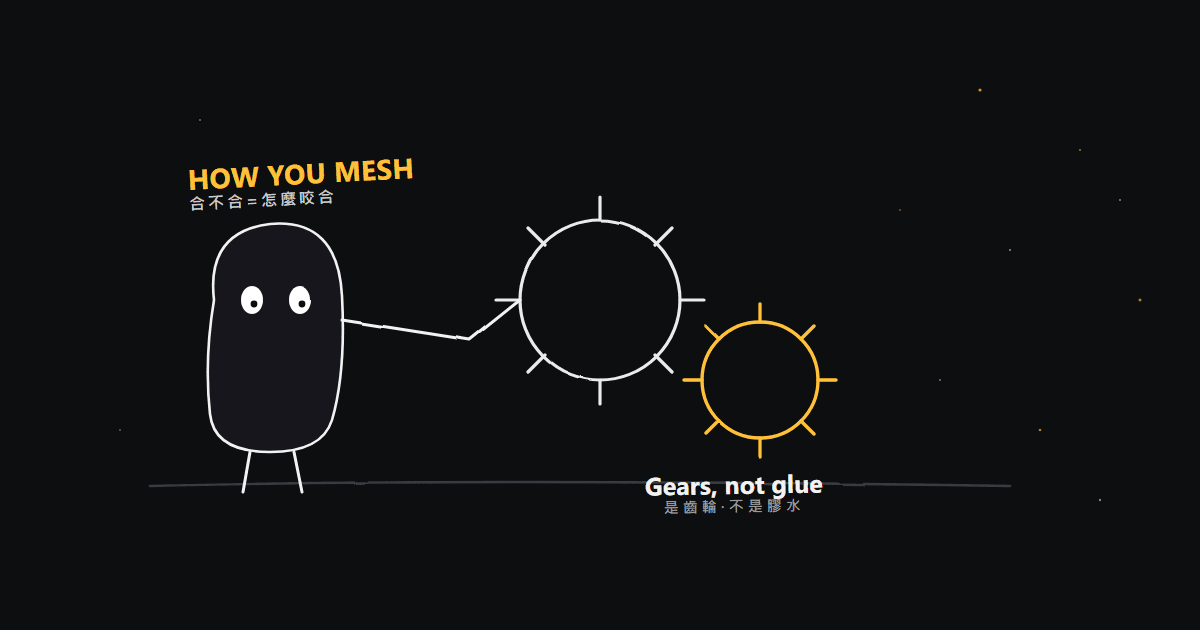
Okay — misconception cleared. Now let's get concrete. How does a Zi Wei Dou Shu compatibility reading work? I'll walk you through it using one image: two machines running side by side, and how their gears mesh.
Imagine each person is a machine with its own gears, rhythms, and heat spots. A compatibility reading places both machines next to each other and watches how the gears engage. I look at three layers.
Layer 1: Do your base rhythms sync?
Everyone has a built-in tempo — a default way of moving through life and emotion. Some people run hot and fast: feelings arrive like a summer storm, intense and then gone; an argument ends with a hug and it's over. Others run slow and low: everything simmers beneath the surface, and they need three days to fully process what happened.
Jessica runs hot. Her partner runs slow.
Neither is wrong. They're just different stoves. The question a compatibility reading asks first is: do these two rhythms complement each other, or do they grind? A fast-hot person paired with a slow-low person can be a beautiful combination — one ignites, one steadies. But it can also be exhausting: one person desperately wants an immediate response, while the other is still warming up inside. The difference isn't in the pairing itself — it's whether both people understand what kind of stove the other is.
Jessica's core problem was here. She was holding her partner to a fast-stove standard, expecting immediate heat from someone who's constitutionally a slow cooker.
Layer 2: Are the rooms you care about most the same rooms?
In Zi Wei Dou Shu, a birth chart contains twelve palaces — you can think of them as twelve rooms in a person's life. There's a Wealth Palace, a Career Palace, a Health Palace, a Children Palace, a Property Palace, a Friends Palace, a Fortune/Wellbeing Palace, and more. Every person has one or two rooms where the lights burn brightest — the areas they invest in most, care about most, organize their life around.
The second layer of a compatibility reading overlays both people's "bright rooms" and sees what the overlap looks like.
If one person's brightest room is Career and the other's is relationships, you get a classic dynamic: one perpetually charging outward, one craving presence and connection. That's not automatically bad — some of the most stable partnerships have exactly this "one advances, one holds" structure. But if neither person names it, the one charging outward starts feeling suffocated ("why are you so clingy?"), and the one craving connection starts feeling abandoned ("all you care about is work"). The pattern isn't the problem. The invisibility of the pattern is.
Layer 3: Which buttons do you push in each other?
This is the subtlest layer — and in many ways the heart of what a compatibility reading is actually for.
Zi Wei Dou Shu has a system that tracks how energy flows and transforms between people — in the tradition, this is called the "four transformations" (四化, si hua). You don't need to remember that term. Just hold this image: everyone carries a set of buttons. And when certain people get close, specific buttons get pressed — automatically, without anyone meaning to.
Some buttons, when pressed, light the other person up: they feel seen, energized, more alive. Being with you makes me better. Other buttons, when pressed, trigger an immediate defensive response: a flash of irritation, a wall going up, a vague unease that's hard to explain. You didn't do anything wrong, but I suddenly feel like retreating.
A compatibility reading maps which buttons you press in each other — and whether those are the energizing kind or the destabilizing kind.
What actually determines whether a relationship flows or struggles is rarely how much you love each other. It's how easily you accidentally press each other's pain points.
When I looked at Jessica and her partner's charts together, I saw a textbook version of this. When she gets anxious, her instinct is to move closer, seek confirmation, ask for a response. That exact action happens to press his button — the one that triggers "I need space; if I feel crowded, I pull back." So the more she reaches, the more he retreats. The more he retreats, the more anxious she gets. Two perfectly reasonable people, locked in a loop that tightens itself automatically.
This is exactly the kind of thing a compatibility reading can show you — and that you absolutely cannot see when you're inside the loop yourself.
IV. So… Are They Compatible? The Answer Lives in the Friction Points
By now you can probably guess what I said when Jessica asked me "so are we actually compatible?"
"You're not incompatible," I told her. "You're snagged. But the snag is exactly the kind you can loosen."
Her chart and his chart, overlaid, showed no "heaven-made match" and no "elemental clash." What it showed was one clear friction point: her sense of security comes from being responded to immediately. His sense of security comes from not being pressured. Both needs are completely normal. The problem is that in the same moment, they step on each other's feet.
Once that's named, the "what do we do?" has a direction. I didn't give Jessica a verdict — I gave her three concrete things:
First: Recognize that his slowness isn't indifference. His stove runs low. Give him three days, and what he produces might be richer than you expected. The delay isn't rejection.
Second: When anxiety hits and you want to reach for immediate confirmation — don't press the button. Try a different phrasing: "I'm feeling a little unsettled right now. You don't have to respond immediately — I just wanted you to know." Shifting from "give me an answer" to "here's my state" means his withdrawal button doesn't get triggered.
Third: He needs to understand that her "pushing" isn't control — it's fear. When he actually gets that, the reflex to retreat softens on its own.
Notice: I never once said "you're compatible" or "you're not compatible." Because the truth about whether two people work together is this — there's no such thing as a naturally perfect pair. There are only two people who've learned how their gears mesh and are willing to adjust together.
The greatest value of a compatibility reading isn't telling you "is this person right for you?" It's handing you a mirror so you can see clearly which loop you're caught in — because once you can see it, you have a chance to step out of it.
The saddest cases I've seen are people who were scared off by a fortune teller's "you two clash" verdict — when what they actually held in their hands was a detailed relationship manual, and someone read it to them like a death sentence instead.
Six months later, Jessica reached out again. This time, no "are we compatible?" She said: "I get it now. He doesn't love me less. He just loves me in a language I couldn't read before. I learned to wait for what he's slowly cooking."
That time, she drank her coffee while it was still hot.
V. The One Thing This Article Wants to Leave You With
If you're sitting with "do we actually work together?" spinning in your head right now — here's what I want to say to you:
Stop looking for the "compatible" or "not compatible" verdict. It doesn't exist. What exists is: how do your gears mesh, where are you snagged, and how might you loosen it?
A Zi Wei Dou Shu compatibility reading won't make the decision for you. It can't — and it shouldn't. The final call in any relationship is always yours. But it can do something quietly powerful: it takes the loops and patterns and stoves and buttons that you're living inside of — too close to see clearly — and spreads them out in front of you. It turns "how did we end up like this?" into "oh — this is why. And here's a way through."
Understanding what kind of stove your partner runs on. Knowing which buttons you're likely to press in each other. Many relationships that look like "we're just not compatible" are actually just "we never saw how the other person worked."
If you're curious what your chart looks like — and what it might reveal about how you relate to others — you can get a free chart at fatestar.top and start there. For more real-talk reads on what the palaces actually mean in everyday life, the FateStar blog has you covered. And if you want a scholarly background on the tradition itself, the Wikipedia entry on Zi Wei Dou Shu is a solid starting point.
No rush to find an answer. Start with understanding. That's already the right direction.
What the classics say
The Complete Book of Zi Wei Dou Shu (Ming dynasty) says: "Read the Spouse palace by examining each star's brightness in detail." In this article's context: classical matching examined how two configurations mesh in detail - "incompatible, therefore discard" appears nowhere. A couple chart is a manual, not a verdict; that stance is ancient and current alike.
FAQ
Do both birth hours need to be accurate?
Yes. One hour shifts entire palaces. If one side is uncertain, rectify first or do a single-side pattern reading.
What if the result says "incompatible"?
Translate it: "higher adjustment cost." Unpack the specific gaps (money style, space needs) into house rules - cheaper than changing partners.
How often is a couple reading worth redoing?
At decade-cycle switches or new stages (moving in, pre-wedding, parenting) - the theme changes.
Disclaimer: Zi Wei Dou Shu (Purple Star Astrology) is an analytical framework rooted in traditional Chinese culture. This article is intended for self-reflection and relationship communication only — it is a decision-support tool, not professional medical, legal, financial, or relationship advice. How your relationship unfolds is always your call.
⚠️ FateStar generates and interprets your chart based on the traditional Chinese discipline of Zi Wei Dou Shu (紫微斗数). All content is for informational and reflective purposes only.
About the Author

Founder of FateStar. He began structured study of San He Zi Wei Dou Shu in 2020 and is responsible for product method, source organization, and content review. Personal experience is not presented as scientific proof.
More about Louis →