Chinese Astrology Beyond the Zodiac: What Zi Wei Dou Shu Reveals That Your Sign Can't
Most people think Chinese astrology begins and ends with the zodiac animal. You're a Dragon, your friend is a Rabbit, and somewhere between fortune cookies and lunar new year placemats, that's supposed to tell you something meaningful about your life. But real Chinese astrology goes far beyond the zodiac, and it can be more accurate than the twelve signs you already know.
It doesn't. Not really.
What most of the English-speaking world calls "Chinese astrology" is actually the shallowest layer of a system that goes extraordinarily deep. The zodiac animal is layer one. Beneath it sits Ba Zi (Four Pillars of Destiny), which uses your exact birth year, month, day, and hour to map energy flows across time. And beneath that — the deepest layer most Westerners have never heard of — is Zi Wei Dou Shu (紫微斗数), a thousand-year-old system that generates a unique 12-palace life map from your birth data, producing over 518,400 distinct chart configurations.
Curious about your own chart? Cast it free in 30 seconds →
This article is about that deepest layer: what it is, how it differs from Western astrology, and why AI is making it accessible to anyone for the first time in history.
The Three Layers of Chinese Astrology
Think of Chinese astrology as a building with three floors. Most people in the West have only ever visited the lobby.
Layer 1: The Chinese Zodiac (What Everyone Knows)
The 12 animals — Rat, Ox, Tiger, Rabbit, Dragon, Snake, Horse, Goat, Monkey, Rooster, Dog, Pig — cycle through years on a 12-year rotation. It's real Chinese astrology, but it's the broadest possible brush: every person born in the same year shares the same animal sign. That's roughly 130 million people per sign at current world population. You wouldn't accept a medical diagnosis shared with 130 million people. Why accept a personality profile that blunt?
Layer 2: Ba Zi / Four Pillars (The Time Map)
Ba Zi uses your birth year, month, day, and hour to construct four "pillars," each with a heavenly stem and an earthly branch. This gives you eight characters (hence "eight characters" — ba zi) that map the five-phase energy balance at the moment of your birth. Ba Zi reads your life as a timeline: which decades bring what kind of energy, when opportunities cluster, when caution is warranted.
Ba Zi is genuinely powerful. It's also the system most English speakers encounter when they search for "Chinese astrology chart" and find something more detailed than the zodiac. But it's still oriented along a single axis: time.
Layer 3: Zi Wei Dou Shu (The Life Map)
Zi Wei Dou Shu — literally "Purple Star Calculation Method" — adds a second axis: space. Using the same birth data as Ba Zi, it generates a map of 12 palaces, each governing a distinct life domain (career, relationships, wealth, health, and eight more). Into these palaces, 14 major stars and dozens of minor stars are distributed according to precise astronomical-calendrical algorithms.
The result is not a timeline but a spatial blueprint of your life. Each palace tells you something specific: what your relationship patterns look like (Spouse Palace), how you earn and lose money (Wealth Palace), what your relationship with authority figures looks like (Parents Palace). The interplay between palaces — especially opposing palaces that pull against each other — creates a three-dimensional portrait that no zodiac sign or single-axis system can produce.
Zi Wei Dou Shu vs Western Astrology
If you're coming from a Western astrology background, the comparison is illuminating:
| Dimension | Western Astrology | Zi Wei Dou Shu |
|---|---|---|
| Birth data | Date, time, location (latitude/longitude matters) | Date and time only (solar-to-lunar calendar conversion; location not used) |
| Core structure | 12 houses, 10 planets, aspects between planets | 12 palaces, 14 major stars, four-transformation dynamic overlay |
| What drives the reading | Planetary positions in the zodiac belt; angular relationships between planets | Which stars occupy which palaces; how the four transformations modulate energy |
| Time cycles | Transits, progressions, solar returns | Major Life Period (大限, ~10 years each), Annual Period, Monthly/Daily Periods |
| Personality engine | Sun sign, Moon sign, Rising sign | Life Palace star combination + opposing Travel Palace |
| Relationship reading | Venus sign, 7th house, synastry chart overlay | Spouse Palace stars + four-transformation activation + opposing Career Palace |
| Output format | Circular chart with planets on the ecliptic | Square or circular chart with stars distributed across 12 life-domain palaces |
The deepest structural difference: Western astrology tracks planets moving through space in real time (where is Saturn right now relative to where it was when you were born?). Zi Wei Dou Shu is a fixed symbolic architecture calculated once from birth data, then activated by time-cycle overlays. You don't need to know where Jupiter is tonight. Your chart is already complete — the question is which parts of it are currently "lit up" by the current year's energy cycle.
For Western astrology practitioners, the closest analogy to Zi Wei's four transformations (Si Hua) is a transit system — except instead of external planets triggering natal positions, the year's heavenly stem activates four specific stars in your fixed chart, directing energy toward opportunity (化禄 Hua Lu), authority (化权 Hua Quan), reputation (化科 Hua Ke), or obstruction (化忌 Hua Ji) in whichever palace those stars occupy.
The 12 Palaces: A Map of Everything That Matters
Imagine your life as a twelve-room house. Each room has a designated function, and the stars occupying each room determine whether that domain runs smoothly or turbulently.
| Palace | What It Governs |
|---|---|
| Life (命宫) | Core personality, outward presence, life trajectory |
| Siblings (兄弟) | Brothers, sisters, close partnerships, peer dynamics |
| Spouse (夫妻) | Romance, marriage, intimate relationship patterns |
| Children (子女) | Offspring, creative output, mentorship |
| Wealth (财帛) | Earning style, financial patterns, cash flow |
| Health (疾厄) | Physical constitution, vulnerability areas, stress patterns |
| Travel (迁移) | External environments, relocation, international opportunities |
| Friends (交友) | Social circle quality, subordinates, network strength |
| Career (官禄) | Professional path, public achievement, calling |
| Property (田宅) | Real estate, home environment, foundational stability |
| Spirit (福德) | Inner life, sense of fulfillment, mental well-being |
| Parents (父母) | Parental relationships, authority figures, institutional support |
These palaces are not isolated cells. Opposing palaces create constant dialogue: your Career Palace faces your Spouse Palace — career growth and relationship dynamics are structurally linked. Your Wealth Palace faces your Spirit Palace — how you earn money directly shapes your inner peace. This spatial tension is the analytical engine of the system.
The 14 Major Stars: Characters in Your Life Story
Each of the 14 major stars carries a vivid personality archetype:
| Star | Archetype | Energy |
|---|---|---|
| Zi Wei (Purple Star) | Emperor, leader | Authoritative, stabilizing |
| Tian Ji (Heavenly Machine) | Strategist, analyst | Quick-witted, adaptable |
| Tai Yang (Sun) | Public figure, giver | Outgoing, generous, visible |
| Wu Qu (Martial Melody) | General, executor | Decisive, pragmatic |
| Tian Tong (Heavenly Unity) | Child, peacemaker | Gentle, comfort-seeking |
| Lian Zhen (Pure Virtue) | Reformer, artist | Sharp, creative, rule-questioning |
| Tian Fu (Heavenly Vault) | Treasurer, conservative | Accumulating, preserving |
| Tai Yin (Moon) | Sensitive soul, introvert | Delicate, emotional, artistic |
| Tan Lang (Greedy Wolf) | Charmer, multi-talent | Magnetic, desire-driven |
| Ju Men (Giant Gate) | Debater, truth-seeker | Persuasive, analytical |
| Tian Xiang (Heavenly Minister) | Coordinator, diplomat | Supportive, norm-following |
| Tian Liang (Heavenly Beam) | Guardian, mentor | Protective, wise |
| Qi Sha (Seven Killings) | Warrior, lone wolf | Intense, volatile, driven |
| Po Jun (Breaking Army) | Pioneer, revolutionary | Disruptive, innovative |
When Tan Lang (the Charmer) sits in your Career Palace, you're wired for roles requiring personal magnetism. When Wu Qu (the General) occupies your Wealth Palace, your financial style is direct and action-oriented. The star-palace combination creates the specific "flavor" of each life domain.
Major Life Periods (大限): Your Life in Chapters
One of Zi Wei Dou Shu's most distinctive features is the Major Life Period (大限, Da Xian) system. Your life is divided into roughly ten-year chapters, each governed by a different palace in your chart. As you move from one period to the next, different stars and palaces activate — literally shifting which parts of your life map are "turned on."
This is why two people with similar charts can have radically different experiences at different ages. A difficult star combination in your third Major Life Period (roughly ages 25–34) doesn't mean your whole life is difficult — it means that decade has specific challenges, while other decades may flow easily.
The practical value: if you know which Major Life Period you're currently in, you can see which domains are energized and which require more caution. It's not prediction — it's pattern recognition applied to your life architecture.
Why AI Is Changing Everything
For most of its thousand-year history, Zi Wei Dou Shu was accessible only to scholars, monks, and the wealthy who could afford a skilled reader. The system's depth was also its barrier: reading a chart well requires simultaneously holding 12 palaces, 14+ stars, four transformations, and multi-layer time cycles in your head.
Large language models change this equation fundamentally. The structured nature of Zi Wei Dou Shu — 12 defined palaces, stars with quantifiable attributes, rule-based transformation mechanics — makes it naturally compatible with AI analysis. Unlike Ba Zi, which relies heavily on oral mnemonics and interpretive "feel" passed from teacher to student, Zi Wei's architecture reads like a programming language: stars have attribute tags, palaces have function definitions, transformations have directional rules.
This is why FateStar was built specifically around Zi Wei Dou Shu. Not as a generic "AI fortune teller" — as a conversational AI that understands the classical system deeply enough to walk you through your own chart in plain language, the way a patient teacher would.
The chart calculation is handled by a verified algorithmic engine (no AI guessing at math). The interpretation — the part that used to require years of study — is where AI adds genuine value: explaining what the star-palace combinations mean for your specific life domains, in language you can actually use.
FAQ
Is Chinese astrology just the 12 zodiac animals?
No. The animal sign is only the surface layer that most people in the West know. Beneath it sit Ba Zi (Four Pillars) and Zi Wei Dou Shu, which use your full birth date and hour to build a far more detailed personal chart. The zodiac animal is shared by everyone born that year; the deeper systems are unique to you.
Is Chinese astrology more accurate than zodiac signs?
It tends to feel more specific because it works from your exact birth time, not just your birth year or month. Where a sun sign groups millions of people together, Zi Wei Dou Shu maps 14 stars across 12 life palaces into hundreds of thousands of configurations. It describes structural tendencies rather than fixed predictions, so treat it as a window, not a verdict.
Is Zi Wei Dou Shu the same as Ba Zi?
No. They use the same birth data but operate on different dimensions. Ba Zi reads your life as a timeline (which energy flows when). Zi Wei reads it as a spatial map (which life domains are structured how). They're complementary, not competing. Think of latitude vs longitude — both are coordinates, but they measure different things.
How is it different from Western astrology?
Western astrology tracks real planetary positions and their angular relationships. Zi Wei Dou Shu is a symbolic system calculated from birth data — it doesn't reference current planetary positions. The output is also different: instead of "your Venus is in Scorpio," Zi Wei says "Tai Yin with Hua Ji sits in your Spouse Palace" — a specific star with a specific modulation in a specific life domain.
Can I read my own chart?
With modern tools, yes. Getting a complete chart generated takes seconds. Understanding the basics — which stars are in your Life Palace, what your major life period looks like — takes a few hours of reading. Deep interpretation takes months to years. AI bridges the gap: it can give you a detailed preliminary reading while you're still learning the system's vocabulary.
What if I don't know my exact birth time?
Zi Wei Dou Shu is sensitive to birth hour — a two-hour difference can shift the entire chart. If you're uncertain, methods exist for "chart calibration": matching known life events against different possible charts to find the best fit. An uncertain birth time doesn't make the system useless, but it does mean treating core-palace readings with more caution.
See Your Own Chart
A thousand years ago, reading this system required a Taoist scholar. Today, you enter your birth details and see your complete 12-palace chart in seconds.
If you've never seen your Zi Wei Dou Shu chart, the experience is worth having. Not because the chart predicts your future — but because understanding your own energy architecture is a surprisingly useful starting point for decisions that actually fit who you are.
Get your Zi Wei Dou Shu chart at FateStar →
FateStar is a conversational AI built specifically for Zi Wei Dou Shu — not a generic fortune-telling chatbot, not a Ba Zi calculator. It generates your complete chart using a verified classical engine (San He school parameters), then walks you through what it means in plain language. Ask it anything about your career, relationships, finances, or current life period.
This article reflects the author's personal research and observations from over five years of Zi Wei Dou Shu study and more than three hundred chart readings. Nothing here constitutes medical, legal, investment, or any other professional advice. Metaphysical systems support self-understanding — all choices remain entirely your own.
What the classics say
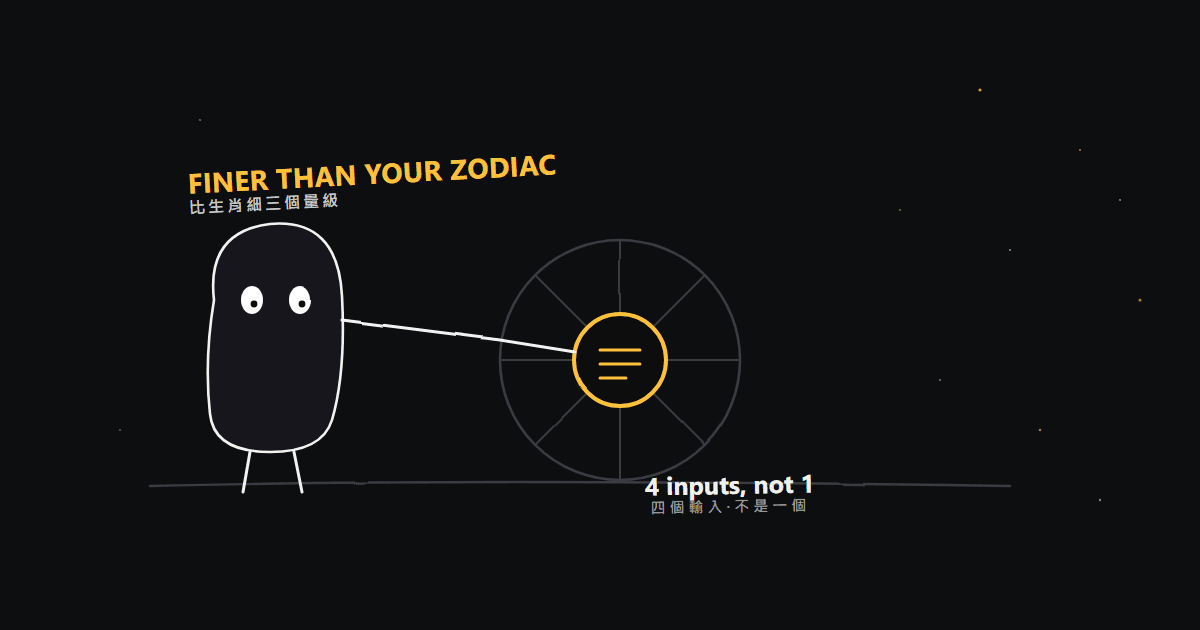
The Complete Book of Zi Wei Dou Shu (Ming dynasty) says: "Only the year, month, day and hour of birth matter." In this article's context: the zodiac uses one input (year); Zi Wei uses four (year, month, day, hour) - three orders of magnitude finer. That gap is exactly where "what your zodiac can't tell you" comes from.
Disclaimer: This article is cultural commentary on Zi Wei Dou Shu, for self-reflection and entertainment only - not medical, legal, financial, or any professional advice.
⚠️ FateStar generates and interprets your chart based on the traditional Chinese discipline of Zi Wei Dou Shu (紫微斗数). All content is for informational and reflective purposes only.
About the Author

Founder of FateStar. He began structured study of San He Zi Wei Dou Shu in 2020 and is responsible for product method, source organization, and content review. Personal experience is not presented as scientific proof.
More about Louis →