Always Attracting the Wrong People? Your Friends Palace in Zi Wei Dou Shu Holds the Answer
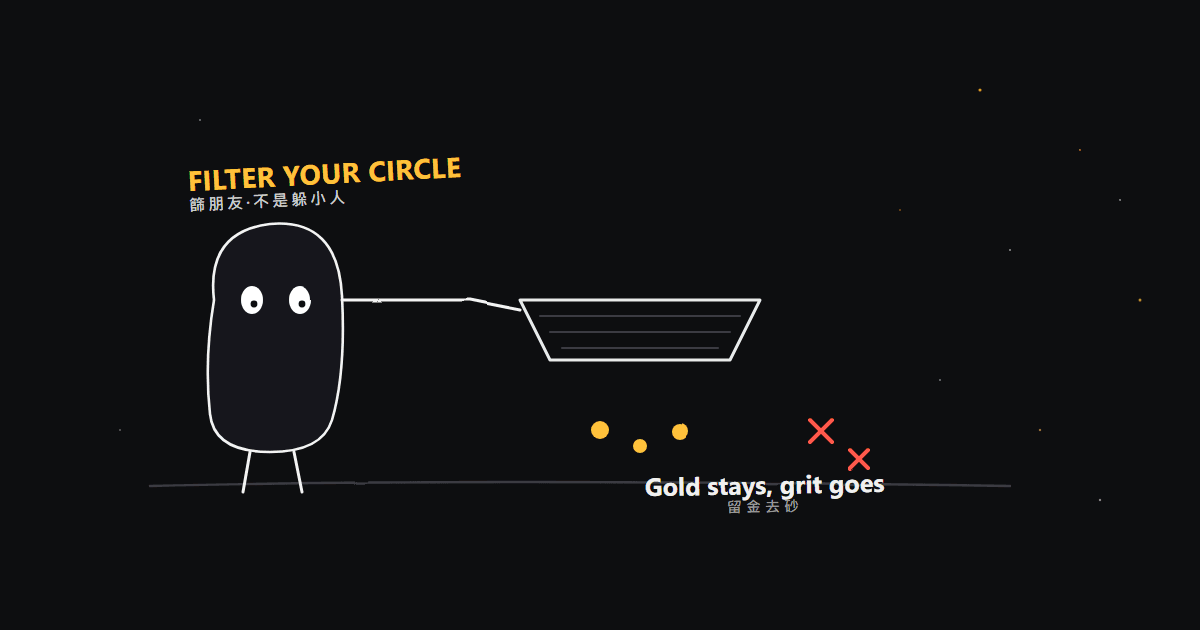
The Winter May Cried Into Her Latte and Asked Me Why
It was a cold evening in Taipei. My friend May sat across from me in a small café, her latte barely touched, eyes red.
"I genuinely can't figure it out," she said. "I stayed late whenever anyone needed help. I covered shifts. I trained the new hire from scratch — walked her through everything. Then last month, she told our manager I was 'emotionally unstable and couldn't lead a team.' She got the promotion. I got nothing."
She looked up at me. "Louis, am I just someone who will always attract the wrong people? Is my entire friendship luck just... broken?"
Curious about your own chart? Cast it free in 30 seconds →
I pulled up her chart and pointed to one section. "Don't cry yet. Let me show you one thing — the Friends Palace."
May's story is not unique. After reading over 300 charts, I keep noticing the same counterintuitive pattern: most people who constantly attract toxic relationships don't lack supporters — they've been mistaking their supporters for background noise and their toxic connections for genuine friends. Today I want to use the one palace in Zi Wei Dou Shu (Purple Star Astrology) that governs human relationships to explain, from the ground up, why some people seem to keep attracting the wrong crowd.
Your kindness doesn't deserve to be exploited. But kindness aimed at the wrong people really does become a cash machine for those who drain you.
What Is the Friends Palace? One Sentence: Your Relationship Map
A quick note on naming. In classical texts, this palace was called the Servants Palace (奴仆宫).
That sounds jarring today — it comes from an era when it literally described the dynamic between a household head and their servants. Modern Zi Wei Dou Shu has renamed it the Friends Palace, and what it now governs is the quality of your relationships with peers, colleagues, subordinates, friends, and partners.
Think of your birth chart as a house with twelve rooms, each one governing a different dimension of your life. One room manages your core identity (Life Palace), one manages marriage (Spouse Palace), one manages money (Wealth Palace). The Friends Palace is the room that records how others treat you — and what kind of people you naturally draw in.
Here's an analogy that makes it click. If your Life Palace is your phone's factory settings, the Friends Palace is your contact list quality. Is it full of fair-weather connections who disappear when things get hard? Or people who would lend you money without hesitation? Is it clogged with numbers that only call when they need something — or is it a shortlist of people who show up when it matters?
Whatever stars sit in that room — and how bright or dim they are — largely defines the baseline texture of your relationships throughout life.
I say "tendency" and "probability," not "fate." That distinction matters enormously, and I'll come back to it.
Why did May keep attracting toxic people? Because the star sitting in her Friends Palace has a very specific personality: deeply nurturing, highly giving — and deeply susceptible to being taken for granted. Her relational default setting, from birth, was set to "give first, no guard up." That's not a flaw. But in the wrong environment, it becomes an open invitation.
Three Common "Relationship Landmine" Profiles — Which One Are You?
After looking at hundreds of Friends Palaces, I've noticed three patterns that show up again and again. See which one lands.
Profile One: The Perpetual Caregiver — overgiving, then resented for it.
These people often have warm, nurturing stars in their Friends Palace (think stars with caretaker energy). Their default phrase is "it's fine, I'll handle it." The hidden trap: when you give without limit, others lose their sense of boundaries. Help someone once and it's a kindness. Help them a hundred times and it becomes an expectation — and the day you can't, somehow you're the one who failed. May is textbook this type.
Profile Two: The Ride-or-Die Type — wide social net, no filter.
These people have a lively, energetic Friends Palace — lots of stars, strong social magnetism, genuinely well-liked across very different circles. The upside is a wide network. The problem is a broken filtering system: they're equally open-hearted with everyone, which means the people who never repay loans, the ones who gossip behind their back, and the ones who only show up when they need a favor are all mixed into the same "close friend" category.
Profile Three: The Lone Wolf — high standards, but accidentally blocking the good ones too.
These people have a quieter Friends Palace, or stars with a more self-contained energy. They prefer few but deep relationships. That sounds safe — but the risk is that when a genuine supporter does reach out, the habitual defensiveness holds them at arm's length too.
The root cause of attracting toxic people is almost never "bad luck." It's a miscalibrated relationship pattern — either the door is so wide open that anyone walks in, or it's so tightly shut that the right people can't enter either.
None of these three profiles is a "bad destiny." They're three different factory settings. Knowing which one you run on tells you which direction to calibrate — and that's the real use of astrology: not a label, but a calibration manual.
What Do Genuine Supporters Look Like? Where Do Toxic People Hide? — Reading the Four Transformations
Stars alone aren't enough. To understand whether you're in a period of attracting supporters or draining connections, Zi Wei Dou Shu has a more precise tool: the Four Transformations (四化, sì huà).
The Four Transformations sound esoteric but the logic is simple. Think of a role-playing game where characters can carry status effects — buffs and debuffs. The Four Transformations work exactly like that. They attach one of four "states" to the stars in your chart:
- Hua Lu (化禄): Like a "harvest aura" — abundance, smooth flow, sweetness in relationships.
- Hua Quan (化权): Like a "power aura" — strength, leadership, your words carry weight.
- Hua Ke (化科): Like a "mentor aura" — good reputation, being noticed by the right people, grace under pressure.
- Hua Ji (化忌), transformation into adversity: Like a "stuck debuff" — blockages, entanglement, disputes, the inability to let go.
When a Hua Lu or Hua Ke star flies into your Friends Palace — that's often a strong signal of supporter energy: your friends bring you real benefits and help your reputation.
When a Hua Ji (transformation into adversity) flies into your Friends Palace — that's the classic pattern of attracting friction. It doesn't mean someone is conspiring against you. It means your interpersonal energy that year is particularly prone to getting stuck: entanglements, disputes, relationships that refuse to resolve cleanly.
Here I need to pause and share something important — a professional note that protects you from being manipulated by amateur readers.
In Zi Wei Dou Shu, ten "heavenly stems" (天干) each trigger different Four Transformation patterns, and different schools calculate them differently. FateStar uses the Sanhe school (三合派) — the most widely practiced and rigorously verified lineage. A concrete example: under the "Geng (庚)" stem, Sanhe calculates: Sun transforms into prosperity (hua lu), Wuqu into power (hua quan), Tiantong into grace (hua ke), and Taiyin into adversity (hua ji).
Why am I spelling this out? Because another school (the Feixing school) reverses the ke and ji for the Geng stem — Taiyin becomes ke, Tiantong becomes ji. With the same chart, the wrong school flips your supporter and your drain completely. This is exactly why, when someone reads your chart, you should always ask which school they use. The wrong direction is more dangerous than not reading at all.
The Four Transformations are the chart's dynamic weather forecast. The stars are the fixed mountains and rivers — the Four Transformations are the moving wind and clouds. To understand relationships, you need to see both what stars sit in the palace and what "states" are currently flying through it.
A Word of Caution: Don't Let Minor Stars Scare You
Before I go further, I need to address a common manipulation tactic.
Some amateur practitioners will point to a minor star in your Friends Palace — something like Tian Xing (天刑) or Hong Luan (红鸾) — and say with great gravity: "Oh no, with this star in your Friends Palace, you're destined to be betrayed by friends."
That is unprofessional. It is also irresponsible.
Here's a hospital analogy. Zi Wei Dou Shu has 14 major stars — think of them as the chief physicians in a hospital: heads of cardiology, neurology. Their diagnostic weight is substantial. The minor stars (Tian Xing, Hong Luan, Tian Yao, and others) are more like the "Watch Your Step" signs posted in hospital corridors — they provide useful context, but they cannot issue a diagnosis, and they cannot determine the verdict on your entire social life.
A minor star carrying less than 5% of the interpretive weight should never single-handedly drive a major conclusion like "you will attract toxic people." Anyone who uses minor stars to frighten you is either under-trained or trying to sell you a "protective charm."
Correct interpretation always goes: first read the major star in the Friends Palace (this sets the baseline character), then read the Four Transformations (this sets the directional energy), and only then do minor stars add nuance as footnotes. Get the order wrong, and the entire reading goes bad.
Four Practical Moves to Attract Better People — Starting Now
Enough theory. Here are four things I tell almost everyone who comes to me for a reading — these work regardless of what your chart looks like.
Move One: Identify your factory setting, then adjust accordingly.
If you're May's type — the perpetual caregiver — your work is learning delayed giving. Instead of saying yes immediately when someone asks for help, try "let me think about it." A little tension in a relationship actually earns more respect than instant availability. If you're the ride-or-die type, your work is building a filter: money and important decisions only go to people who have proven themselves over time. If you're the lone wolf, your work is leaving a crack in the door: aim to build at least one genuinely close new friendship per year.
Move Two: Notice the direction your supporters tend to come from.
Zi Wei Dou Shu can broadly indicate whether your natural supporters tend to be older figures or peers, more often male or female in energy. This isn't superstition — it's a prompt to invest your relationship-building energy in the right direction. If your chart suggests strong elder-figure energy, lean into mentors at work rather than burning energy competing laterally with peers.
Move Three: Treat "adversity years" in your Friends Palace as system maintenance windows.
If a given year's annual cycle activates a transformation into adversity (hua ji) in your Friends Palace — which you can see directly in the major and annual cycles on a free chart at FateStar — that is not the year to aggressively expand your network, enter new partnerships, or lend money to people. Knowing this is a high-friction period means you naturally raise the threshold and keep your cards closer. That foreknowledge is the power.
Move Four: Supporters are built, not waited for.
This is the most important one. Your chart tells you what kind of people you're likely to encounter — but whether those encounters become lasting support is entirely in your hands. Someone who genuinely has your back, ignored and unmaintained over years, fades into a stranger. Someone who once created friction, once you've set firm boundaries and adjusted the dynamic, loses the ability to harm you. The chart gives you the terrain map. You still drive the car.
Zi Wei Dou Shu gives you a topographic map of your interpersonal landscape — here are the mountains, here are the hidden reefs. But the steering wheel has always been in your hands.
One Thing I Want to Leave You With
If you constantly feel like you give and give and somehow still end up on the losing end — the most likely reason isn't that the world is unusually cruel to you. It's that nobody ever taught you how to read people, or how to read yourself.
The Friends Palace doesn't contain your fate as a victim. It contains your relationship operating manual: whether you're naturally inclined to give or to guard, which direction your supporters tend to appear from, which years carry higher friction. Understanding it moves you from reactive to intentional.
What happened to May? She didn't quit her job. But she did one thing differently: she stopped being available to everyone and started choosing who she showed up for. Six months later, she told me that the colleague who had taken her promotion tried the same move on a new manager. Nobody believed it this time — because May had learned to let the right people witness her value, instead of scattering it indiscriminately.
If you've ever thought "I'm genuinely kind to people, so why do I keep getting the short end?" — it might be worth taking a few minutes to look at your own Friends Palace. You can generate your free chart at FateStar and see the palace that has been quietly shaping your relationships all along. More practical Zi Wei Dou Shu breakdowns live in our blog.
Understanding yourself was never about accepting a fixed fate. It's about living more intelligently inside the one life you have.
What the classics say
The Complete Book of Zi Wei Dou Shu (Ming dynasty) says: "The Friends palace reveals the fortune of those around you." In this article's context: the classics used this palace to read whether the people around you add force or drain it. Recurring "backstabbers" are not mystical bad luck - your people-reading pattern is written on the chart, and a seen pattern can be changed.
FAQ
Is always meeting toxic people fate?
It's a pattern, not fate: the palace shows which type you tend to misjudge and where your guard drops. Patterns are fixable.
How to use it practically?
Read the star natures: which temperaments are your helpful people (complementary), which combinations tend to drain (malefic co-presence) - then weight your circle consciously.
Friends palace vs Spouse palace conflict?
Different jurisdictions: Friends governs peers and collaboration; Spouse governs intimacy. No collision.
Disclaimer: Zi Wei Dou Shu (Purple Star Astrology) reflects personality tendencies and probabilities — it is a decision-making reference, not a deterministic prophecy. Nothing in this article constitutes medical, legal, or financial advice. The direction of your life remains entirely your own choice.
⚠️ FateStar generates and interprets your chart based on the traditional Chinese discipline of Zi Wei Dou Shu (紫微斗数). All content is for informational and reflective purposes only.
About the Author

Founder of FateStar. He began structured study of San He Zi Wei Dou Shu in 2020 and is responsible for product method, source organization, and content review. Personal experience is not presented as scientific proof.
More about Louis →