Is Zi Wei Dou Shu Accurate? An Honest Answer After 300 Charts
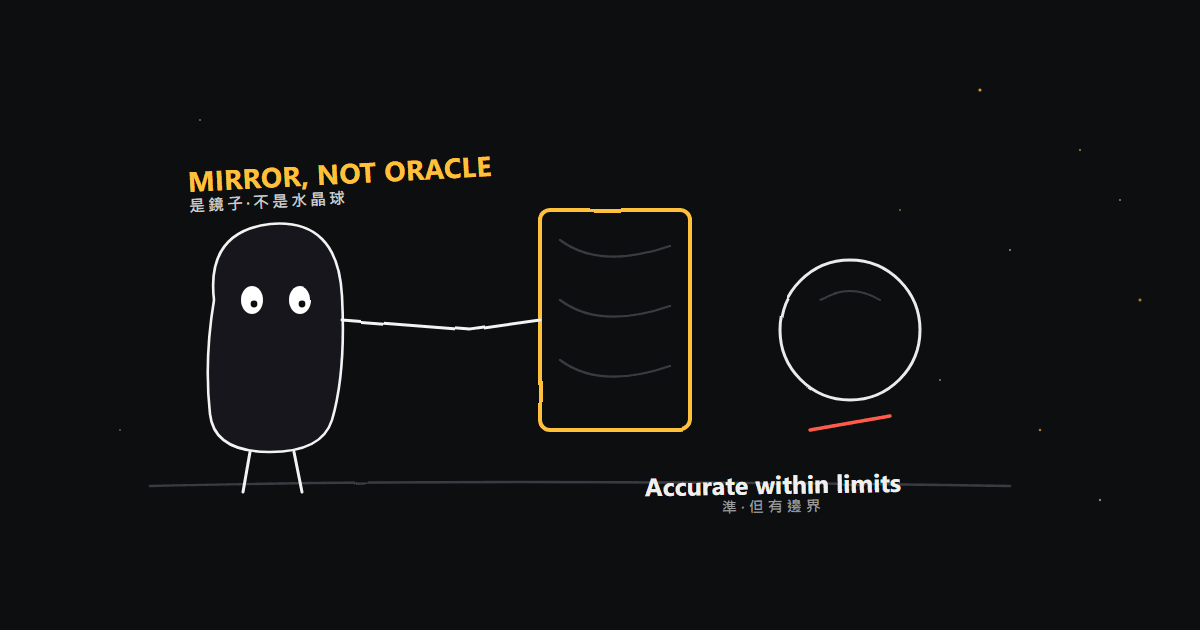
"Is Zi Wei Dou Shu accurate?" - almost everyone's first question on first contact. What they really mean is: "is fortune-telling real, and is this worth trusting?" This article won't tease you, and it won't sell you "100% spookily accurate" either. Here is the honest answer from someone who has read over 300 charts.
Split the question in two: charting accuracy vs interpretation accuracy
Most people treat "accurate" as one question. It is actually two, and mixing them guarantees confusion.
Layer one: charting - deterministic and reproducible. Casting a Zi Wei Dou Shu chart is a fixed algorithm: input the birth year, month, day and hour; the rules place the 14 major stars, minor stars and malefic stars into the 12 palaces and trigger the Four Transformations. Same birth time, same school - the chart comes out identical every single time, like solving an arithmetic problem. No inspiration involved. This layer has no "accuracy" question - only "was it computed correctly."
Curious about your own chart? Cast it free in 30 seconds →
An analogy: casting a chart is like looking up a perpetual calendar. Today's lunar date is a fact; it doesn't change depending on who looks it up.
Layer two: interpretation - probability and perspective, never "100%." Translating the same chart into your life story converts structure into narrative. It yields tendencies - high-probability patterns - not a written verdict. Claiming "100% accurate" is a lie; dismissing it all as superstition is not fair either. It works like a weather forecast: "80% chance of rain today," so you carry an umbrella. That is exactly as much as you should expect.
So where is it accurate, and where is it not?
- Where it lands: personality baseline, working style, the junctions where you tend to get stuck, which phases favor advancing or holding - these "pattern layer" reads are often startlingly on point. The chill-down-the-spine feeling is common.
- What not to expect: precision events like "which day you'll win the lottery" or "the name of your future spouse." The system gives direction and probability, not GPS coordinates. Treat it as a verdict and it will disappoint you.
How a would-be debunker got persuaded by his own charts
A personal note. FateStar's founder Louis came in wanting to prove the whole thing was a scam - classic contrarian. In 2020 he formally studied San He school Zi Wei Dou Shu under a teacher, then read charts for people free of charge, hunting for the crack in the wall.
Five years and 300+ charts later, he never found the "this is fraud" evidence. Instead the patterns kept matching, and he was persuaded by his own readings. Not "converted to mysticism" - he discovered something narrower: when you stop using it as fortune-telling and start using it as a mirror, its value stands.
The question that matters more: how will you use it?
This is the crux. A chart is not a sentence; it is navigation. When navigation says "congestion ahead," the value is not the prophecy of a traffic jam - it is that you can reroute.
The same chart:
- Used as a verdict → "my fate is sealed" → the more you consult it, the more powerless you feel.
- Used as navigation → "this is where I tend to get stuck; I know early, I adjust early" → this is what the ancients called avoiding misfortune and moving toward fortune.
So the straight answer to "is it accurate": the charting layer is reproducibly exact; the interpretation layer gives you high-probability self-knowledge; and its greatest use is helping you decide with clearer eyes - not resigning you to fate.
What FateStar does differently on "accuracy"
- Reproducible, reversible engine: the charting algorithm follows the classical texts strictly; identical input always yields identical output, and all seven time dimensions (annual, monthly, daily, hourly, Dou Jun, decade, minor limit) close mathematically. No "different answer tomorrow."
- One school, locked: the whole site uses the San He school per the Complete Book of Zi Wei Dou Shu - no quiet switching between San He and Fei Xing. Mixed schools are the hidden culprit behind "it doesn't add up."
- No "spookily accurate" marketing: we would rather state the boundaries clearly than oversell you. Accuracy is the baseline; honesty is the stance.
FAQ
Is Zi Wei Dou Shu accurate or not?
Two layers. Charting is deterministic - same birth data, same school, identical chart every time; the only question is whether it was computed correctly. Interpretation gives tendencies and high-probability patterns, like a forecast saying "80% rain." It is strong on personality baseline, working style and where you get stuck - and should never be expected to name dates or people. Honest summary: accurate within boundaries; use it as a mirror, not a verdict.
Is fortune-telling real? Is this the same thing?
Depends what you mean. The street version - instant doom pronouncements plus paid "disaster removal" - is not Zi Wei Dou Shu. ZWDS is a reproducible rule system plus centuries of accumulated pattern experience: closer to a cultural tool for structured self-reflection. It does not promise to change your fate and does not replace professional psychological or medical counsel. Instead of litigating "accurate," use it as navigation: know where you tend to stall, adjust early.
Is AI chart reading accurate compared to a human?
On the charting layer, AI follows the algorithm 100% and makes fewer errors than manual casting. On interpretation, AI's edge is consistency - it integrates patterns from a large corpus of charts and won't say more on a good day and skip a palace when tired. Like a human reader, it provides a reference frame, not a substitute for your judgment or for professional counseling.
Zi Wei Dou Shu vs BaZi - which is more accurate?
No consensus ranking exists. BaZi is macro, reading the strength of the five elements; ZWDS has finer granularity, separately addressing the Spouse, Career, Wealth and other palaces. Many teachers use both. Rather than ranking them, pick one self-consistent, unmixed system and use it consistently.
Rather than asking "is it accurate," cast one and judge for yourself. Generate your free Zi Wei Dou Shu chart at FateStar - San He school algorithm, reproducible engine. Enter your birth date and hour, get a full chart plus AI reading in 30 seconds, and decide whether it reads you right.
⚠️ This article is for cultural study and self-exploration only. It does not constitute medical, legal, financial or other professional advice. FateStar generates charts based on the traditional Chinese system of Zi Wei Dou Shu; all content is for reference only.
⚠️ FateStar generates and interprets your chart based on the traditional Chinese discipline of Zi Wei Dou Shu (紫微斗数). All content is for informational and reflective purposes only.
About the Author

Founder of FateStar. He began structured study of San He Zi Wei Dou Shu in 2020 and is responsible for product method, source organization, and content review. Personal experience is not presented as scientific proof.
More about Louis →