Should I Quit My Job? Your Career Palace in Zi Wei Dou Shu Has a More Honest Answer
May's Latte That Never Got Touched
Last winter, my friend May — who runs her own advertising agency — asked me to grab coffee. The latte arrived. She didn't touch it. She just sighed and said: "I've been my own boss for years, and the person I most want to quit on is myself."
I laughed. She kept going: "Seriously. Every morning I wake up and the first thought is I don't want to go in. But then I think about what I'd do next, and I freeze. Is this a 'wrong job' problem or a 'something's wrong with me' problem?"
I've heard that question at least three hundred times over the past five years. Across the table from me: mid-level managers at big tech companies, fresh graduates in their first role, and self-employed people like May who technically can't be fired but want to fire themselves anyway. The complaint is almost always identical: work feels awful, I think about quitting every day, but I don't know if I actually should.
Curious about your own chart? Cast it free in 30 seconds →
I pulled up May's chart and said one thing to her. She picked up that cold latte and drank the whole thing — not because I'd predicted something magical, but because she'd realized for the first time: "Should I quit?" is not one question. It's two questions stacked on top of each other.
That's what this piece is about. I'm going to separate those two questions using the slice of Zi Wei Dou Shu (Purple Star Astrology) that governs career — the Career Palace — combined with the yearly energy cycle that shifts every twelve months. The goal: help you figure out whether your job misery means you're temporarily stuck, or you were never in the right spot to begin with.
Quitting itself isn't the hard part. The hard part is not knowing what you're running from — or what you're actually after.
Meet the Career Palace: Your Professional Dashboard
Zi Wei Dou Shu, for those new to it, takes the precise time of your birth and maps it onto a twelve-section wheel. Each section — called a "palace" — governs a different domain of life: relationships, money, health, parents. One palace specifically governs how you engage with the working world. That's the Career Palace (官禄宫, guān lù gōng).
Don't let the classical name intimidate you. I always describe it the same way to people I read for: the Career Palace is your professional dashboard.
Think of it like the instrument cluster in a car. You've got a fuel gauge, a speedometer, an engine temperature warning. The Career Palace works the same way — the stars sitting inside it tell you three things:
- How you're wired to work (are you built to charge the front lines, or to architect things from behind the scenes?)
- Your natural advantages and blind spots in professional settings
- What "success at work" actually means to you at the deepest level
Here's a concrete analogy. Some people are built like sports cars — they need speed, creative control, high stakes. Park them in rush-hour traffic and they're miserable. Others are built like off-road trucks — they thrive in complex, grinding, unpredictable terrain. Put them on a racetrack and they're just nervous. The Career Palace doesn't tell you whether you'll succeed. It tells you what kind of vehicle you are. If you're an off-road truck trying to win a Formula 1 race, running badly isn't bad luck — it's a vehicle-road mismatch.
May's Career Palace held a star with a strong drive for authority and decision-making. I asked what her day-to-day actually looked like. She said: "To keep revenue coming in, I've been taking whatever small execution projects I can get. I spend my days revising copy, chasing payments, and soothing clients."
There it was. The problem wasn't her ability. Her sports-car wiring had been squeezed into a single-lane alley that only had room for someone following instructions. Her career unhappiness wasn't a "stuck" problem. It was a "wrong road" problem.
Annual Transits: Why the Same Job Can Feel Great One Year and Unbearable the Next
The Career Palace alone isn't the whole picture. It's fixed — set at the moment you were born, unchanging for life. But you know from experience that the same job that felt energizing two years ago now makes you want to throw your laptop out a window. What changed?
That's where annual transits (流年, liú nián) come in.
Think of transits as the weather. Your birth chart — your Career Palace included — is a house. The house doesn't move. But the weather outside changes every year. Some years are clear and sunny; some years bring month after month of grey drizzle. Same house, very different experience depending on the weather.
Each year, different stars "fly into" your Career Palace and activate what Zi Wei Dou Shu calls the Four Transformations (sì huà). These are four labels that describe the quality of energy entering a palace:
- Hua Lu (transformation into abundance): Flow, opportunity, helpful people showing up, money moving — like someone watered that section of your garden
- Hua Quan (transformation into authority): Influence, decision-making power, the ability to handle real responsibility — like the electricity suddenly working in that room
- Hua Ke (transformation into prestige): Reputation, recognition, being recommended and noticed — like someone finally turned the lights on
- Hua Ji (transformation into adversity): Friction, stagnation, energy drain, everything feeling harder than it should — like fog rolling into that room
A quick note for transparency: the exact star assignments for each transformation depend on which school of Zi Wei you're using. For instance, in a Geng (庚) year, the classical Sanhe school assigns: Sun as Hua Lu, Wu Qu as Hua Quan, Tian Tong as Hua Ke, and Tai Yin as Hua Ji. Some practitioners assign this differently. The chart engine at FateStar follows the Sanhe lineage consistently — I mention this not to bog you down in theory, but because getting one star wrong flips the entire conclusion. The rules matter.
Back to the point. When a year's Hua Ji (transformation into adversity) lands in your Career Palace, you'll feel it viscerally: tasks that used to flow start snagging everywhere, colleagues who were fine become insufferable, you check the clock twelve times before noon. You want out. But here's the critical thing — this is usually the weather, not the house collapsing. Hua Ji clouds in the Career Palace typically clear within a year or two.
Many people quit during a Hua Ji year and only realize later: the job wasn't broken. That was just the year everything felt hard, and quitting was their pressure valve.
Three Signals: Are You Stuck, or in the Wrong Place?
Now we combine the Career Palace (the house) with the annual transit (the weather) and ask the actual question. Here are three signals you can check yourself — no chart reading required yet.
Signal One: Has the wrong-fit feeling been there for years, or just recently?
Go back through your memory honestly. If you've only started dreading work in the past year or two — and before that you were reasonably engaged — that's almost certainly a Hua Ji weather pattern. You're temporarily stuck. The fog will lift.
If, on the other hand, you've felt the mismatch since you joined this company, or even since you entered this industry — and this year just finally broke your patience — that's a wrong-position signal. Your Career Palace wiring was never compatible with this road.
May was clearly the second type. Her authority-driven star had been squeezed into execution work for years. This year was just the final straw.
Signal Two: Would switching teams or managers actually help?
I ask almost everyone I read for a version of this question: "If tomorrow you got a new team, a new direct manager, and a new project — everything else the same — would you stay?"
If the honest answer is "Yeah, I'd give it another shot," that's a stuck signal. The problem is the specific people and dynamics around you, not the fundamental fit. A change of environment could genuinely help.
If the honest answer is "Doesn't matter, I don't want to be doing this," that's a position mismatch. Rearranging the deck chairs won't fix it. Eventually you'll leave no matter what.
Signal Three: Where is your energy actually going?
During a Hua Ji year, your energy gets drained — into rumination, friction with colleagues, frustration that circles but goes nowhere. It's exhausting in an active, buzzing way.
When the position is fundamentally wrong, your energy isn't drained — it's locked out entirely. You can't even work up the effort to be properly frustrated. It's the flat, hollow burnout where you're going through the motions and feeling nothing.
The first is a fever — it breaks and you recover. The second is being in the wrong climate — you need to move, not just wait it out. The confusion between these two is what makes "should I quit?" feel impossible to answer.
Stay, Shift, or Go: A Timing Map for Each Scenario
Once you've sorted which situation you're in, here's how I think about the action and — crucially — the timing.
Stay (熬) — If it's a Hua Ji year and the weather clears next year
This is the most counterintuitive move, and often the most valuable one. If your mismatch feeling is new (Signal One points to "recently"), if a different team would help (Signal Two), and if next year's transit lifts the Hua Ji off your Career Palace — I'd tell you: don't quit yet. Ride out the rainy season.
Quitting during a Hua Ji year means walking into your job search carrying that fog with you. You'll interview badly, attract the wrong opportunities, and likely land somewhere that feels worse within six months. Staying isn't about gritting your teeth and suffering. It's about lowering expectations, conserving energy, and not making permanent decisions based on temporary weather.
Shift (留) — If the position isn't wrong, but your lane is
Sometimes the company is fine. The industry is fine. You have been put in the wrong role.
May didn't close her agency. What she did was change lanes without leaving the road. She gradually outsourced the execution work and pulled herself back into what her Career Palace is actually built for — setting direction, closing major clients, making calls. Same company. Completely different alignment between her wiring and her daily work.
Six months later she told me it was the first time in three years she didn't dread Monday morning.
If this sounds like you: before you draft a resignation letter, try negotiating internally first. A different project, a different reporting line, a different scope of responsibility. Staying in the same company but doing work that fits your Career Palace wiring costs a fraction of what a full job search costs — in time, energy, and psychological toll.
Go (换) — If it's a chronic mismatch, time it to a favorable transit
If Signal One says the wrong-fit feeling has been there for years, and Signal Two says no internal shuffle would fix it — yes, it's time to leave. But how you time it matters.
The best window for a career move is a year when your Career Palace receives Hua Lu (abundance, helpful people, things flowing) or Hua Quan (authority, the ability to negotiate on your own terms). In those years, you walk into interviews with a different energy. Opportunities find you rather than you chasing them. You're more likely to land not just a job, but the right job at the right level.
Leaving in a tailwind year is a career transition. Leaving in a headwind year is an escape. The destination of an escape is rarely better than where you started.
Quitting isn't a yes-or-no question. It's a "when, and in what posture" question.
I don't know from here whether you're a May — someone whose Career Palace has been in the wrong position for years — or someone who's hit a Hua Ji year and the clouds are already starting to thin. But if you run yourself through those three signals honestly, the tangled knot of "should I quit" usually starts to have a thread you can pull.
The One Thing This Piece Is Really Saying
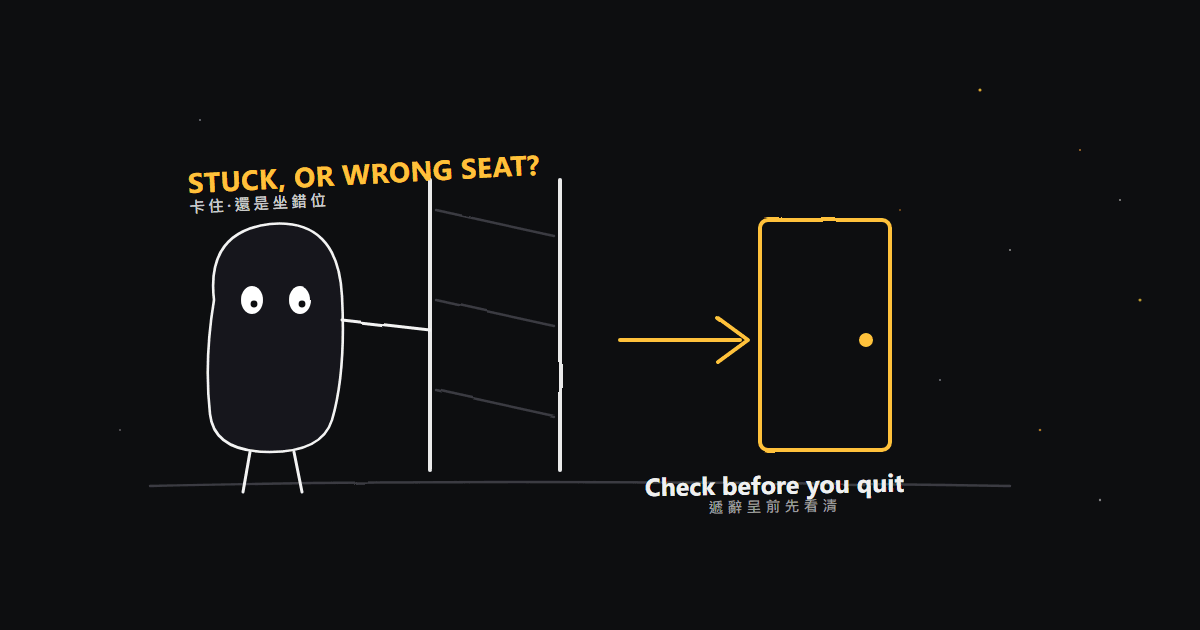
Stop asking "should I quit?" Start asking "am I stuck, or am I in the wrong place?"
Career burnout, Sunday dread, the feeling that your work life is grinding you down — all of that is real, and I'm not dismissing any of it. But the source of the pain changes everything about the right response. Treating a fever with a relocation, or treating climate mismatch with cold medicine — both are a waste. The Career Palace and annual transits in Zi Wei Dou Shu don't make the decision for you. They give you a map. They let you see where on the map you actually are right now — whether you need to wait for this storm to pass, shift lanes inside the same road, or pick a favorable season to genuinely start over.
Map in hand, the decision is still yours. But at least you're not slamming a resignation letter on the table in a bad moment and spending the next year wondering why the next place feels just as wrong.
If you want to see what your own Career Palace looks like — which stars are sitting in it, and what this year's transit is bringing through — you can pull your free chart at FateStar. The chart engine is built to speak plain language; you don't need to know the jargon to get a feel for what you're working with. And if you want more breakdowns like this one, there are a few more over at /blog.
What the classics say
The Complete Book of Zi Wei Dou Shu (Ming dynasty) says: "In the Career palace - met well it shines, met badly it imprisons." In this article's context: "stuck" is the classics' "imprisoned" state of an afflicted Career palace - but imprisonment is conditional; change the combination and it shines. Diagnose wrong-seat versus wrong-timing before you resign.
FAQ
Jump ship or endure - how to tell?
Check the annual cycle: Hua Ji entering Career usually means "feels bad" rather than "wrong seat" - it often passes. Only structural mismatch across years justifies a move.
Can the chart show rage-quit risk?
It shows your cash buffer: if the Wealth palace is clashed the same year, quitting cold doubles the cash-flow risk. Transition while employed.
Changing industry vs changing company - different on the chart?
Industry change touches star-nature fit in the Career palace; company change only touches environment. Only a star-industry mismatch calls for an industry switch.
Disclaimer: Zi Wei Dou Shu is a framework for exploring tendencies and supporting personal decision-making — not a substitute for medical, legal, or financial advice. For significant career, health, or financial decisions, combine any astrological insights with real-world context and professional guidance.
⚠️ FateStar generates and interprets your chart based on the traditional Chinese discipline of Zi Wei Dou Shu (紫微斗数). All content is for informational and reflective purposes only.
About the Author

Founder of FateStar. He began structured study of San He Zi Wei Dou Shu in 2020 and is responsible for product method, source organization, and content review. Personal experience is not presented as scientific proof.
More about Louis →