Is AI Fortune-Telling Reliable? What to Trust and What to Skip
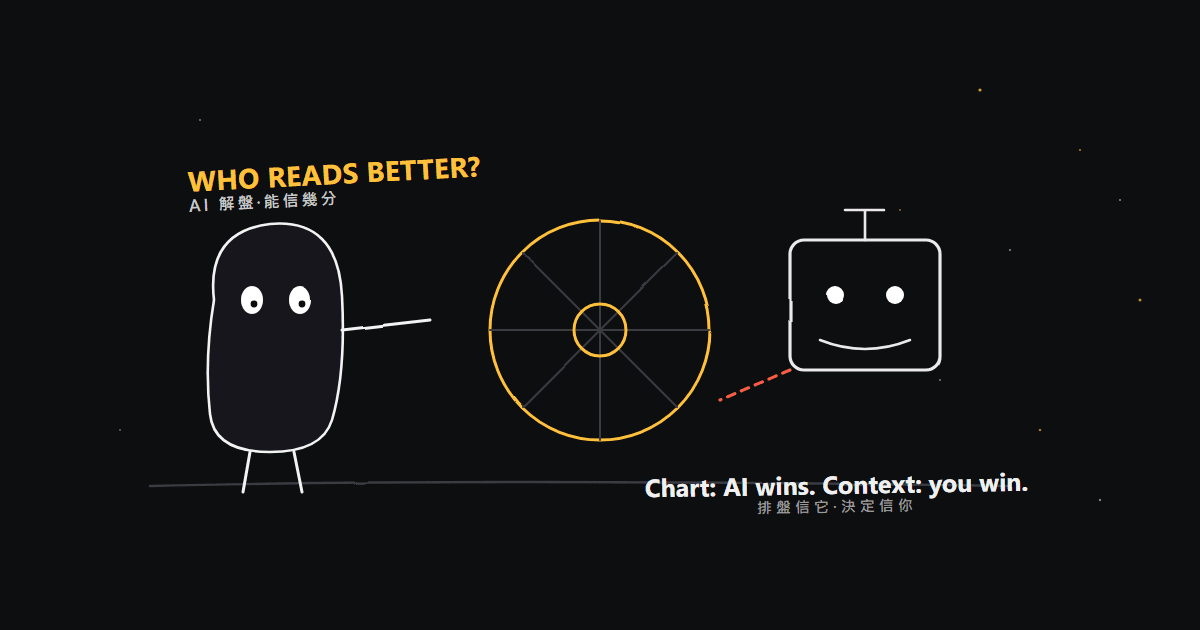
"AI + mysticism" is now a money-making genre on short-video platforms. As someone who builds an AI Zi Wei Dou Shu product, let me pour some cold water on my own industry: the phrase "AI fortune-telling" needs to be split in two before you can judge it.
AI charting vs AI interpretation
Charting: the algorithm wins, full stop.
Casting a Zi Wei chart is deterministic: birth date and hour in, fourteen major stars placed, transformations triggered - every step is fixed arithmetic. The Complete Book of Zi Wei Dou Shu states it plainly: only the year, month, day and hour of birth matter. A machine follows the rules 100% of the time and never copies a star into the wrong palace. Veteran readers use software for this too.
Curious about your own chart? Cast it free in 30 seconds →
Interpretation: AI has a strength and a ceiling.
The strength is consistency. A human reader elaborates when fresh and skips palaces when tired; AI walks the same structured depth every time.
The ceiling is context. The same Lian Zhen Hua Ji means different things to a fresh founder and a soon-to-retire teacher. Good reading requires follow-up questions - and most AI products spit one-shot results without asking you anything.
Three standards for judging an AI astrology product
1. Does it show you the chart? A product that gives conclusions without the chart is a chef who won't show the dish. Charting output should be fully transparent so you can verify it.
2. Does it state its school? Transformation tables differ between lineages (the Geng stem difference is famous - see the Four Transformations guide). A product that won't name its school may be mixing tables. FateStar locks the whole site to the San He school for exactly this reason.
3. Does it promise "100% accuracy"? Instant disqualification. Charting is reproducible; interpretation is always probability. Whoever promises magic either doesn't understand the boundary or is exploiting you.
The right way to use AI astrology
Treat AI as a first-pass scan, not a final verdict:
- Use it to cast instantly and sweep the twelve palaces - its best skill
- Use it to learn: ask "why this reading?" - good AI can cite the rule
- For life-sized decisions (marriage, resignation, investment), never rely on any single reader - human or AI. The decision stays yours.
FAQ
Q: Will AI interpretation beat a human teacher? Charting layer: yes (no manual errors). Interpretation: split decision - AI wins consistency and coverage, humans win contextual probing. Best practice: AI for the base layer, your own judgment on top.
Q: Is my birth data safe with AI fortune-telling apps? Depends on the product. Birth time is sensitive personal data - use platforms with an actual privacy policy, not anonymous mini-apps.
Q: Free vs paid AI readings - what's the real difference? Rarely the algorithm (charting rules are public). Usually interpretation depth and human review. Cast free first, see the structure, then decide.
Disclaimer: This article is cultural commentary on Zi Wei Dou Shu, for self-reflection and entertainment only - not professional advice of any kind.
Cast a free chart at FateStar - no login required.
Classical references: Complete Book of Zi Wei Dou Shu (Ming dynasty); Tai Wei Fu.
⚠️ FateStar generates and interprets your chart based on the traditional Chinese discipline of Zi Wei Dou Shu (紫微斗数). All content is for informational and reflective purposes only.
About the Author

Founder of FateStar. He began structured study of San He Zi Wei Dou Shu in 2020 and is responsible for product method, source organization, and content review. Personal experience is not presented as scientific proof.
More about Louis →