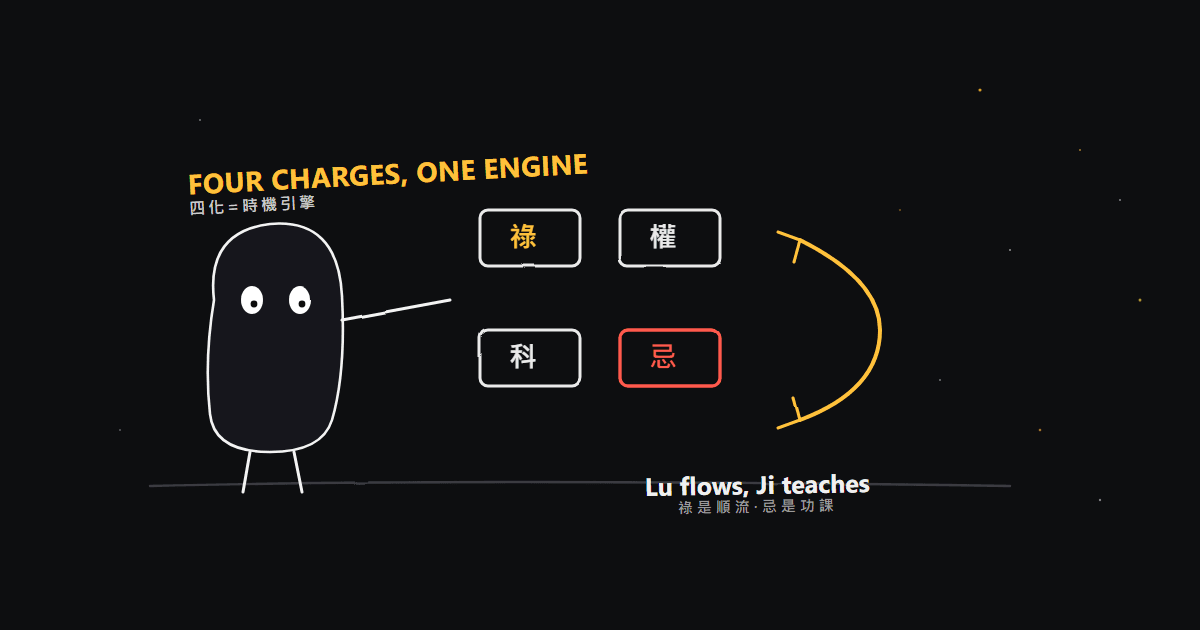
If the stars in a Zi Wei Dou Shu chart describe who you are, the Four Transformations (Si Hua, 四化) describe how energy moves through your life — and when. They are the single most important mechanism in the whole system, and the reason Zi Wei is so good at timing. Miss them, and you are only reading half the chart.
This guide explains what the Four Transformations are, how they are derived, why they drive timing, and the one school difference you must know about. It is a companion to our complete guide to Zi Wei Dou Shu.
What are the Four Transformations?
The Four Transformations are four "charges" that attach to four specific major stars in your chart. Based on the Heavenly Stem of your birth year, four stars each receive one of these:
Curious about your own chart? Cast it free in 30 seconds →
- 化禄 (Hua Lu) — Flow / Reward. Opportunity, smoothness, resources, the area where things come to you. Your natural gift.
- 化权 (Hua Quan) — Power / Drive. Authority, ambition, the push to take control and make things happen.
- 化科 (Hua Ke) — Reputation / Clarity. Recognition, good name, learning, the area where you shine and are seen.
- 化忌 (Hua Ji) — Friction / Fixation. The sticking point, the obsession, the lesson you keep circling back to. Not "bad luck" — the area asking for the most growth.
Think of the four stars as four students in a classroom, and the transformations as four labels the teacher pins on them for the year: gifted, driven, honored, and needs work. The same student gets a different label depending on which year (which stem) you are reading.
How they are derived
Every year has a Heavenly Stem (there are ten: Jia, Yi, Bing, Ding, Wu, Ji, Geng, Xin, Ren, Gui). Your birth year's stem fixes your natal Four Transformations — the ones baked into your personality.
But the same rule applies to any year, month, day, or hour. So you can take this year's stem and lay this year's Four Transformations over your natal chart. That overlay is what turns a static personality map into a moving timeline.
Why they are the timing engine
This is the part that makes Zi Wei special. By stacking transformations from different time layers — your natal chart, the current decade luck (大限), the annual (流年), even monthly and daily — you can see which life palace is lit up right now.
For example: if this year's Hua Lu (reward) lands in your Career palace, it is a tailwind year for work. If this year's Hua Ji (friction) lands in your Spouse palace, relationships are the area asking for patience and attention. The transformations do not announce fixed events — they tell you where the energy concentrates and when. (For how the palaces themselves work, see our 12 palaces guide.)
That is why a serious annual reading is not "good year or bad year." It is "here is the palace that gets the tailwind, here is the one that needs care, and here is the window to act."
The school difference you must know
Here is where readings quietly go wrong. Different lineages use different transformation tables. For most year stems they agree, but a few stems differ between schools — most famously the Geng (庚) stem.
FateStar is locked to the San He (三合) school. For the Geng stem, San He assigns:
- Hua Lu → Tai Yang (太阳)
- Hua Quan → Wu Qu (武曲)
- Hua Ke → Tian Tong (天同)
- Hua Ji → Tai Yin (太阴)
The competing Fei Xing lineage swaps the last two (Ke to Tai Yin, Ji to Tian Tong). Neither is "wrong" — they are different traditions — but mixing them silently is one of the most common ways a reading becomes incoherent. A trustworthy reading states which school it follows. We say ours out loud.
How to use your Four Transformations
- Find your natal four. Which palaces hold your Hua Lu, Quan, Ke, and Ji? Hua Lu is your natural gift area; Hua Ji is your lifelong lesson.
- Read Hua Ji with respect, not fear. It marks where you fixate or struggle — and therefore where your biggest growth lives. It is a teacher, not a curse.
- Overlay the current year. Where do this year's transformations land? That tells you which palace to lean into and which to protect this year.
- Look for "double hits." When a natal transformation and an annual transformation land in the same palace, that area is strongly emphasized that year.
- Use it before deciding, not after. The transformations are a planning tool — a map of where the road climbs and dips — not after-the-fact proof.
Want to see your own four? Cast a free chart or start a guided reading and ask where your transformations fall.
Frequently asked questions
What are the Four Transformations in Zi Wei Dou Shu? They are four "charges" — Hua Lu (reward/flow), Hua Quan (power/drive), Hua Ke (reputation/clarity), and Hua Ji (friction/lesson) — that attach to four major stars based on a year's Heavenly Stem. Your birth year sets your natal transformations; any year's stem can be layered on to read timing.
Is Hua Ji (化忌) bad luck? No. Hua Ji marks the area where you tend to fixate or face friction — your hardest lesson — but it is not "bad luck." Read well, it points to where your most important growth and attention belong. Treating it as a curse is exactly the kind of fear-based misreading a disciplined practice avoids.
Why do different astrologers give me different transformations? Because lineages use different transformation tables for certain year stems — the Geng (庚) stem is the famous example, where San He and Fei Xing schools disagree on two of the four. This is normal, but a reading should state which school it follows. FateStar is locked to the San He school and says so.
Do the Four Transformations predict exact events? No. They show where life energy concentrates and when a palace is emphasized — tailwinds, friction points, and timing windows. They are best used as a planning and reflection tool before decisions, not as a prediction of specific events.
About the author
This guide was written by Louis Lin (林靖翔), founder of FateStar. Louis began studying Zi Wei Dou Shu seriously in 2020 under his teacher and has since read 300+ charts. He built FateStar to bring a rigorous, San He-school reading to people who do not read classical Chinese — with the honesty that a chart is a compass, not a guarantee.
What the classics say
The Complete Book of Zi Wei Dou Shu (Ming dynasty) says: "When Lu meets a clash, fortune hides misfortune." In this article's context: the Four Transformations are never read in isolation: even the best Hua Lu discounts under a malefic clash. This classical warning is the earliest source of "always read transformations with the full palace triangle."
Disclaimer: This article is for cultural, educational, and self-reflection purposes only. Zi Wei Dou Shu is a traditional interpretive system and does not constitute professional, medical, financial, or legal advice. Use it as one input among many, alongside your own judgment.
⚠️ FateStar generates and interprets your chart based on the traditional Chinese discipline of Zi Wei Dou Shu (紫微斗数). All content is for informational and reflective purposes only.
About the Author
Founder of FateStar. He began structured study of San He Zi Wei Dou Shu in 2020 and is responsible for product method, source organization, and content review. Personal experience is not presented as scientific proof.
More about Louis →