The Complete Beginner's Guide to Ziwei Dou Shu's 12 Palaces — A Map of Your 12 Life Rooms
Here's what happened.
My friend X sent me her ziwei chart screenshot last week with one question. Louis, which of these 12 boxes matters most. If you've ever opened your own chart and wondered the same thing, this is a beginner's guide to the 12 palaces of Zi Wei Dou Shu — the Chinese astrology houses that work like 12 rooms of your life — and how to read a natal chart without drowning in jargon.
I stared at her chart for a while before answering. Not because I didn't know. Because the question itself was framed wrong. Asking which of the 12 palaces matters most is like asking which of your 12 ribs matters most. They all do. Take any one out, you collapse.
Curious about your own chart? Cast it free in 30 seconds →
A more precise answer is this. The 12 palaces aren't ranked by importance. They're a holographic map of one person. Each palace is one layer of you. Together, they form the complete picture.
I've studied ziwei for over five years and read more than 100 charts I've actually tracked. What moved me from beginner to someone who could give friends sound input wasn't memorizing the 14 main stars. It was the day I finally saw how opposing palaces pull at each other. That gestalt moment, where all the stars suddenly come alive at once, is the threshold of real understanding.
This article is my attempt to walk you through that threshold.
A small disclaimer first. I'm still learning ziwei. Don't read this as an authoritative explanation. Read it as a slightly experienced friend telling you what he's worked out over five years. After reading, you'll still need to go back to your own chart and verify everything against your own life.
Let's begin.
Ziwei dou shu divides your life into 12 sections. They're not evenly distributed or random. Starting from your birth hour, they wind counterclockwise around the chart in a fixed sequence. Life palace first, then siblings, spouse, children, wealth, all the way through to parents palace. Twelve sections, twelve life dimensions.
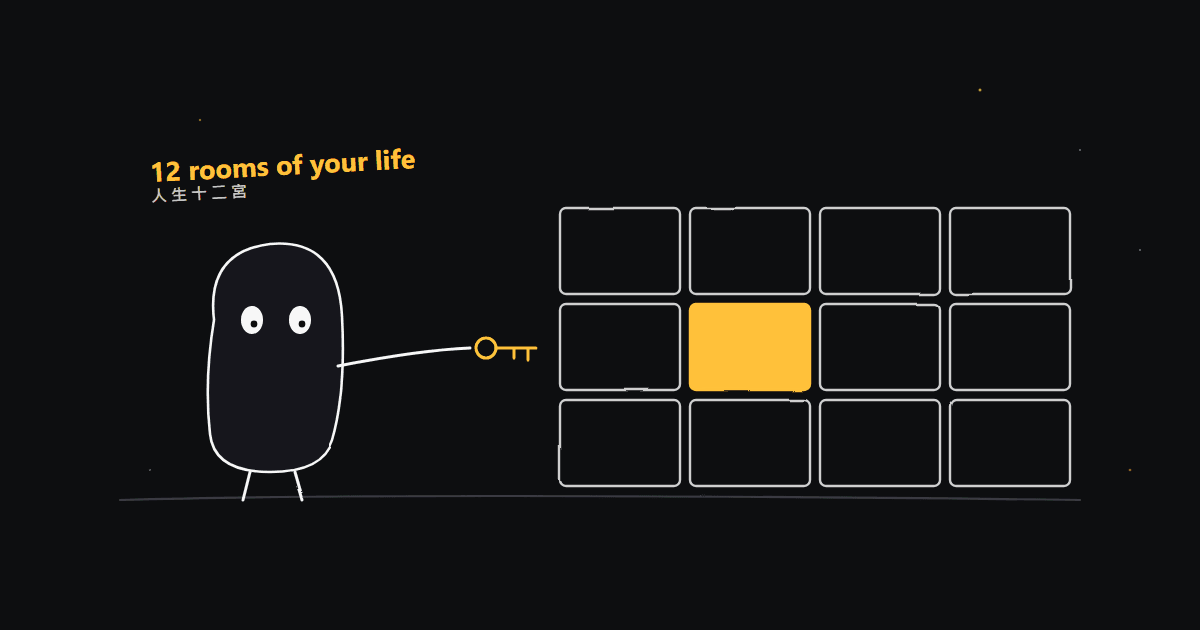
Think of it this way. Your life is a 12-room house. Each room has its own function. The living room (life palace) is you yourself. The bedroom (spouse palace) decides your intimate relationships. The study (career palace) is your work life. The vault (wealth palace) is how you make money. The meditation room (happiness palace) is your inner world. These 12 rooms aren't isolated. They share one foundation and they trade light and air between them. The brilliance of ziwei isn't telling you what each room looks like. It's telling you how the 12 rooms interact.
Let me walk through each one. Plain language, not jargon. Be prepared though, truly understanding your own 12 palaces takes more than one article. You'll need to hold up your real chart against your real life events three to five times. That's a year of work, not one evening.
1. Life Palace. You, yourself. Your core personality, your default reactions, your instinctive choices. Whatever main star sits here sets your base operating system. Ziwei command people lead by instinct. Tai Yin command people read rooms quietly. Tian Ji command people overthink everything. The life palace is your starting OS, not your destination.
A lot of beginners think ziwei reading is just reading the life palace. Wrong. The life palace is the launch point. I've seen two people with identical life palaces live such different lives that they couldn't understand each other.
2. Siblings Palace. Your peers. Brothers and sisters, but also business partners, coworkers, the people on your level. If you don't have siblings, this palace doesn't go quiet. It quietly tells you your "peer collaboration capacity." Someone with Tian Fu here tends to be the steady anchor in groups. Someone with Qi Sha tends to fight with co-founders.
My siblings palace is empty with borrowed Zuo Fu Yu Bi. People with this setup usually find their real "siblings" later in life, not by birth, by choice.
3. Spouse Palace. Your intimate relationships. This one my friends ask about most. It's also the hardest one I've had to learn to talk about cleanly.
The spouse palace shows the pattern you replay in intimate relationships. Not who you'll marry. Not when you'll fall in love. The pattern that auto-repeats whenever you're close to someone. Tian Liang here tends to draw older partners. Lian Zhen Hua Ji here tends to spin people into emotional loops that recreate the same drama for decades, unless they actively work on themselves.
The stars here describe what you become in intimacy. Not what your partner is. This distinction matters. Miss it and you'll blame your partner for life instead of meeting yourself.
4. Children Palace. Your extensions. Children, sure. But also students, the books you write, the products you build, the things you put into the world. This palace shows how you relate to your extensions and whether you'll sacrifice for them.
My children palace explains why I build FateStar as a long-haul product. It tells me I have parenting energy, not flip-and-quit energy. Once you see that, you stop fighting it.
5. Wealth Palace. How you make money. Not whether you'll be rich. How.
Wu Qu here, you earn through execution. Tan Lang here, you earn through charisma and network. Tian Ji here, you earn through thought and planning. Force yourself into the wrong mode and short term you might survive, long term you'll burn out.
I'll write a deeper piece on this. Each of the 14 main stars in the wealth palace produces a completely different earning pattern.
6. Health Palace. Your body and your pressure points. Not just illness. Where your body breaks down first and where stress shows up first.
Fire and Bell stars here, sudden small problems. Tian Tong here, stress drives emotional eating. A palace hit by Hua Ji is the part of yourself you spend a lifetime learning to live with.
My health palace tells me I burn out by overriding rest signals. Knowing this, I now force rest days. That's the practical value of a chart.
7. Travel Palace. Your public face. Travel literally, but more importantly, how you appear when you leave home and deal with the outside world. The opposite of the life palace, so they pull on each other forever.
Good travel palace means luck with strangers, smooth fortune away from home. Difficult travel palace means random friction outside. Deeper still, it shows what other people see when they look at you. Your life palace is you as you think you are. Your travel palace is you as others perceive you. The gap between the two is your friction coefficient with the world.
8. Servants Palace. Your subordinates and friend circle. Old word, modern meaning. This shows your capacity to use people and whether your friend group nourishes or drains.
Lian Zhen here, your friend group is vivid but draining. Tian Liang here, you'll have loyal but slightly rigid friends. Good servants palace and starting a company is easy. Bad servants palace and you'll do better as a solo operator.
9. Career Palace. Your work and professional identity. Different from wealth palace. Wealth is how you earn. Career is what role you play.
Many people have wealth and career palaces pointing different directions. That's why some people have mediocre main jobs but successful side gigs, or impressive jobs that don't pay well. The tension between these two is the source of most career anxiety.
The career palace also shows your relationship with authority. Ziwei here tends to want to be a boss. Tai Yin here finds success in behind-the-scenes work.
10. Property Palace. Your foundation. Real estate literally. Deeper meaning, your roots. Family atmosphere, family resources, your relationship to settling down.
Good property palace, stable upbringing, easy time owning a home as an adult. Hit property palace, you may move many times in life or have a complicated relationship with your family of origin.
This palace correlates strongly with sense of safety. Its shape determines how much external structure you need before you can actually relax.
11. Happiness Palace. Your inner world. This is my favorite. It shows your capacity to enjoy your inner state, your "cost of joy."
Tian Tong here, a cup of bubble tea makes your week. Tan Lang here, you need constant novelty to feel alive. Lian Zhen Hua Ji here, the foggy "I have everything but feel empty" state.
The happiness palace pairs with the wealth palace as opposites. Their tension explains why some people earn little but live happy and some earn a fortune and stay anxious.
12. Parents Palace. Your origin. Parents, elders, authority figures. Deeper still, what you inherited. Not money. Patterns. The way your parents treated you tends to be the way you'll treat your children, unless you actively interrupt it.
Hit parents palace usually means there's family-of-origin work to do. Good stars here means resources and shelter from elders.
I spent years processing my own parents palace. This homework doesn't end until you actively finish it.
The 12 palaces, listed. But they only come alive when you see how opposite palaces pull on each other.
The San He school (the one I use) emphasizes opposing palace dynamics. The 12 palaces pair up into 6 axes, and each axis is in constant tension.
Life ↔ Travel. Who you think you are vs. who others see. Siblings ↔ Servants. Your peers vs. your subordinates. Spouse ↔ Career. Your intimacy vs. your professional identity. Children ↔ Property. Your extensions vs. your roots. Wealth ↔ Happiness. How you earn vs. how you spend mental energy. Health ↔ Parents. Your body's stress vs. inherited patterns.
Always read each axis as a pair. Reading one palace alone gives you misleading conclusions.
My own example. My wealth palace is execution-driven, Wu Qu Hua Quan style. My happiness palace is Tai Yin, which is a star that demands quiet thought and slow rhythm. The two together mean I can earn execution money, but if I live at full execution pace, my inner world collapses. My optimal mode is "execution earning paired with significant solo time." Seeing this stopped me from feeling guilty about my pace.
That's the magic. One palace is one-dimensional. An axis is two-dimensional. Then the "four critical palaces" (life + wealth + career + travel, the cross-pattern of any chart) gives you three-dimensional structure.
How do you use this? Three steps.
First, see your base configuration. Life palace main star plus the four-critical-palaces. This is your wiring. It doesn't change.
Second, see this year's Hua Ji. Annual Hua Ji marks your major theme of the year. Hua Ji on spouse, this year is about relationships. Hua Ji on career, this year is about work. Once you see it, you can allocate energy intentionally.
Third, see what gets pulled by the year's main theme. Hua Ji never operates alone. Its opposite palace gets pulled too. Knowing the pulled palace prepares you mentally for collateral effects.
Three steps. With these you have 70% of useful ziwei. The remaining 30% is decade limits, detailed transformations, minor stars. That's for people who want to go deep.
You're probably tired. Ziwei carries a lot of information. I needed three full readings of the 12 palaces before I started seeing them.
The 12 palaces aren't 12 answers to 12 questions. They're a hologram. Each palace is a small mirror. Stack 12 mirrors together and you can see yourself completely for the first time.
Above the entrance of the temple at Delphi was the inscription "know thyself." Philosophers have been chasing that for thousands of years. Ziwei dou shu, in my view, offers one path. Not the only path. But a path especially well-suited to Chinese speakers.
If you want to try it, the simplest start is to read your own chart, look at the palace that matters most to you right now, and slowly extend to others. Don't try to absorb everything in one sitting. Give yourself six months to a year.
Read your 12-palace chart on FateStar →
FAQ
What are the 12 palaces in Zi Wei Dou Shu?
They're the 12 sections of your natal chart, the Chinese astrology houses that each cover one life dimension — life, siblings, spouse, children, wealth, health, travel, servants, career, property, happiness, and parents. Think of them as 12 rooms of one house. Read together, not ranked, they form a holographic map of who you are.
How do I read my natal chart as a beginner?
Start small. Look at your life palace main star, then add the four critical palaces (life, wealth, career, travel) for structure. Read each palace alongside its opposite, since the pairs pull on each other. Don't try to absorb all 12 at once — hold the chart against real life events over several months and patterns slowly surface.
Which palace matters most?
None on its own. Asking which of the 12 palaces matters most is like asking which rib matters most — remove any and the structure weakens. The palace worth your attention first is simply the one tied to what you're facing right now, whether that's a relationship, a career turn, or money. Then extend outward from there.
What the classics say
The Complete Book of Zi Wei Dou Shu (Ming dynasty) says: "Only the year, month, day and hour of birth matter." In this article's context: the twelve palaces are built from nothing but your birth time - a purely structural system, which is exactly why they read as neatly as twelve rooms in one house.
Disclaimer: This article is cultural commentary on Zi Wei Dou Shu, for self-reflection and entertainment only - not medical, legal, financial, or any professional advice.
⚠️ FateStar generates and interprets your chart based on the traditional Chinese discipline of Zi Wei Dou Shu (紫微斗数). All content is for informational and reflective purposes only.
About the Author

Founder of FateStar. He began structured study of San He Zi Wei Dou Shu in 2020 and is responsible for product method, source organization, and content review. Personal experience is not presented as scientific proof.
More about Louis →