Human Reader or AI? The New Choice in Getting Your Chart Read
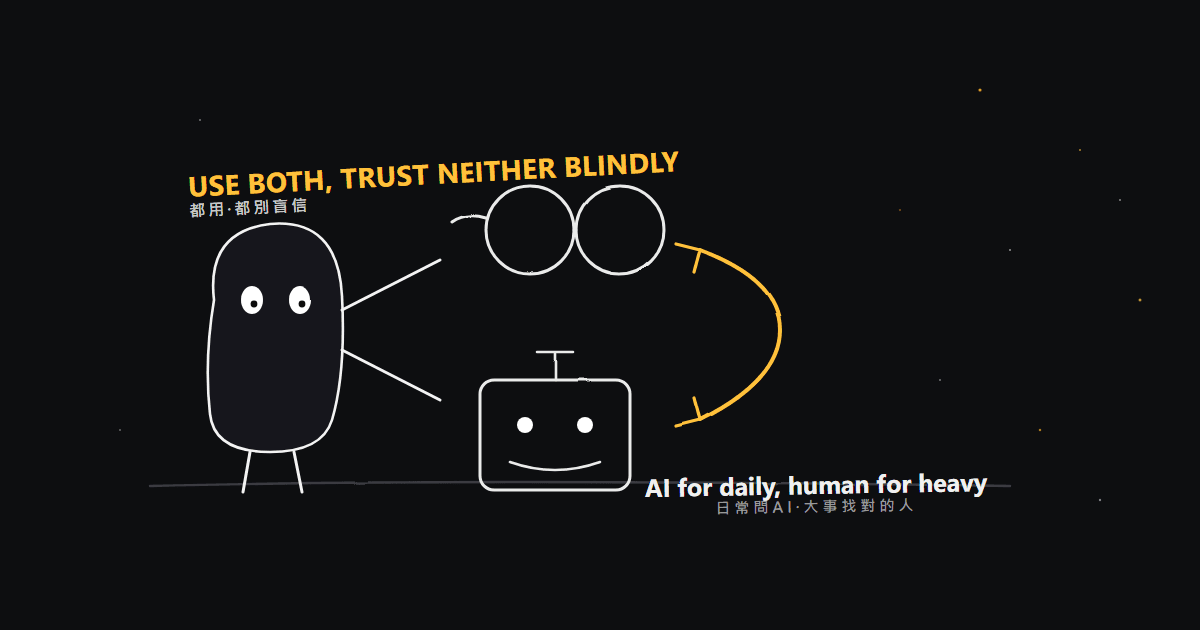
Forums keep asking "any trustworthy Zi Wei reader in town?" - and someone always replies "just use AI now," igniting the usual war.
My position is awkward: I build an AI Zi Wei product, and I learned under a human teacher. So here's the answer that annoys both camps: it depends on which problem you're solving.
What humans do that AI can't (yet)
1. Probing. A good reader spends half the session asking: "Did you change tracks recently? Any elder-health matters at home?" Answers continuously recalibrate the reading - a depth of interaction most AI products lack.
Curious about your own chart? Cast it free in 30 seconds →
2. The weight of lived experience. When a 60-year-old reader says "hold through this decade," behind it sit hundreds of real lives watched end to end. Algorithms don't carry that gravity.
3. Presence. Many people seek a reader not for information but for an authoritative companion in uncertainty. That's a psychological need - legitimate and real.
What AI does that humans can't
1. Flawless casting. Charting is pure algorithm; AI never mis-places a star. This layer is settled - veteran readers use software too.
2. Consistency. Ask the same chart ten times, get the same structured answer. A human's mood, fatigue, and schedule all leak into their output.
3. Zero upsell. AI doesn't end a reading with "you'll need a ritual for this - special price." That alone has saved people fortunes in fear-tax.
4. Availability + dumb-question tolerance. Anxious at 3 a.m.? AI's awake. Need "what is Hua Ji" explained ten times? AI never sighs.
The hybrid strategy
- Daily learning, annual check-ins, small questions → AI. High frequency, low stakes, information-seeking: AI wins on economics alone.
- Life-sized calls (marriage, career pivot, the psychology of a big investment) → add a vetted human as a second reading. Vetting standard: the 5 red flags - doom-speak and paid dissolution deserve zero tolerance in the AI era.
- Whoever you ask: the decision stays yours. Reader and AI are both advisors, never the commander.
FAQ
Q: Won't AI just hallucinate readings? Product-dependent. Sound AI grounds every reading in explicit rules (star + palace + transformation) and declares its school; improvising AI deserves the same bin as improvising humans. See AI fortune-telling: what to trust.
Q: Expensive readers = accurate readers? No. Price tracks fame and market, not accuracy. The eternal standard: can they show the rules, and do they hand the decision back to you?
Q: What school does FateStar's AI use? San He school, locked site-wide (per the Complete Book of Zi Wei Dou Shu), transformation tables never mixed, full chart always visible - because transparency is the first virtue of AI astrology.
Disclaimer: This article is cultural commentary on Zi Wei Dou Shu, for self-reflection and entertainment only - not professional advice of any kind.
Cast a free chart at FateStar - no login required.
Classical references: Complete Book of Zi Wei Dou Shu (Ming dynasty); Tai Wei Fu.
⚠️ FateStar generates and interprets your chart based on the traditional Chinese discipline of Zi Wei Dou Shu (紫微斗数). All content is for informational and reflective purposes only.
About the Author
Founder of FateStar. He began structured study of San He Zi Wei Dou Shu in 2020 and is responsible for product method, source organization, and content review. Personal experience is not presented as scientific proof.
More about Louis →