Zi Wei Uses the Lunar Calendar, BaZi Uses Solar Terms: One Ancient Line Explains It
A line from the Complete Book of Zi Wei Dou Shu circulates in astrology threads and deserves a proper unpacking:
"Xi Yi observed the stars above and built Dou Shu to read human fate - not following the five stars' passing of solar terms, only the year, month, day, and hour of birth."
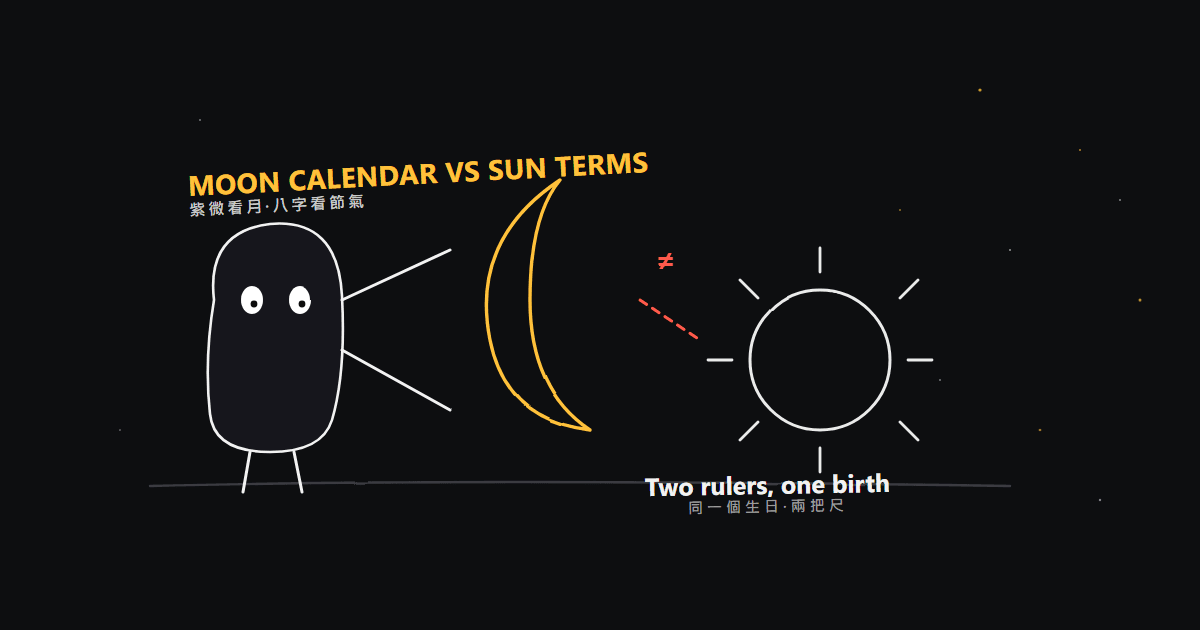
Two short clauses that mark the deepest split between Zi Wei Dou Shu and BaZi: they run on different calendars.
Curious about your own chart? Cast it free in 30 seconds →
BaZi follows the sun (solar-term calendar)
BaZi's year and month boundaries are solar terms:
- The year changes not at Lunar New Year but at Li Chun (Start of Spring)
- Months change at each month's jie term (Jing Zhe, Qing Ming, Li Xia...)
Solar terms track the sun's position on the ecliptic - BaZi is fundamentally a solar-calendar system, which is why its five-element seasonal logic binds so tightly to the natural seasons.
Zi Wei follows the moon (lunar calendar)
"Only the year, month, day and hour of birth" - Zi Wei uses the raw lunar calendar:
- Year changes at the first day of the first lunar month
- Months change at each new moon (day 1)
- Life palace and star placement all derive from lunar month + day + hour
A moon calendar, indifferent to solar terms. Hence the pointed phrase "not following the five stars' solar terms" - "five stars" referring to the star-astrology traditions of the era that switched months at solar terms. Chen Xiyi's new system explicitly declared independence from that convention.
The practical consequence
The same person can occupy different "months" in the two systems.
Example: born on lunar January 3rd, before Li Chun arrives -
- Zi Wei: already a first-month baby of the new year
- BaZi: still the previous year's twelfth month (Chou month)
Neither is wrong; they are different coordinate systems - Fahrenheit and Celsius reporting the same temperature with different numbers.
Leap months are Zi Wei's special homework. The lunar calendar inserts leap months (BaZi never sees them - solar terms don't leap). Zi Wei has explicit leap-month rules (a common convention: first half counts as the current month, second half as the next - schools vary). This is why a charting tool must document its leap-month handling.
Why this matters
Because content that blends "Zi Wei + BaZi" carelessly often collides at the calendar layer: casting Zi Wei with Li Chun year-boundaries, or reading BaZi with new-moon months - producing charts that are simply wrong.
A quick rigor test for any tool or teacher: "When does your year change - lunar day one, or Li Chun?" A crisp answer signals sound fundamentals; a blank stare tells you everything downstream is shaky.
FAQ
Q: I only know my solar (Western) birthday - problem? No - tools convert automatically. Just be precise about the date: midnight-adjacent births need care about which day they belong to.
Q: Born before Li Chun - which zodiac animal am I? Folk custom uses the lunar year (changes at New Year); BaZi practice uses Li Chun. Both conventions coexist - just know which coordinate system you're speaking in.
Q: Do solar terms matter at all in Zi Wei? Not for star placement ("not following the solar terms"). Some schools reference them in fine-grained judgments, but mainstream San He practice: lunar calendar for the chart, solar terms stay out of it.
Disclaimer: This article is cultural commentary on Zi Wei Dou Shu, for self-reflection and entertainment only - not professional advice of any kind.
Cast a free chart at FateStar - no login required.
Classical references: Complete Book of Zi Wei Dou Shu (Ming dynasty); Tai Wei Fu.
⚠️ FateStar generates and interprets your chart based on the traditional Chinese discipline of Zi Wei Dou Shu (紫微斗数). All content is for informational and reflective purposes only.
About the Author

Founder of FateStar. He began structured study of San He Zi Wei Dou Shu in 2020 and is responsible for product method, source organization, and content review. Personal experience is not presented as scientific proof.
More about Louis →