The first time I had my ziwei chart read, back in 2020, an astrologer scared me badly with a single sentence — and it taught me the most-abused trick in all of Chinese astrology.
He said, young man, your 命宫 contains 天刑 (heaven's punishment star). You need to be careful of blood-related calamity for life.
I froze. Blood calamity is the kind of phrase that lands hard. I went home and spent the entire night reading every interpretation of 天刑 I could find. The more I read, the more nervous I got. For a full week I drove cautiously, checked traffic lights three times before crossing, treated everything like a hazard.
Curious about your own chart? Cast it free in 30 seconds →
A week passed. Nothing happened.
A month passed. Still nothing.
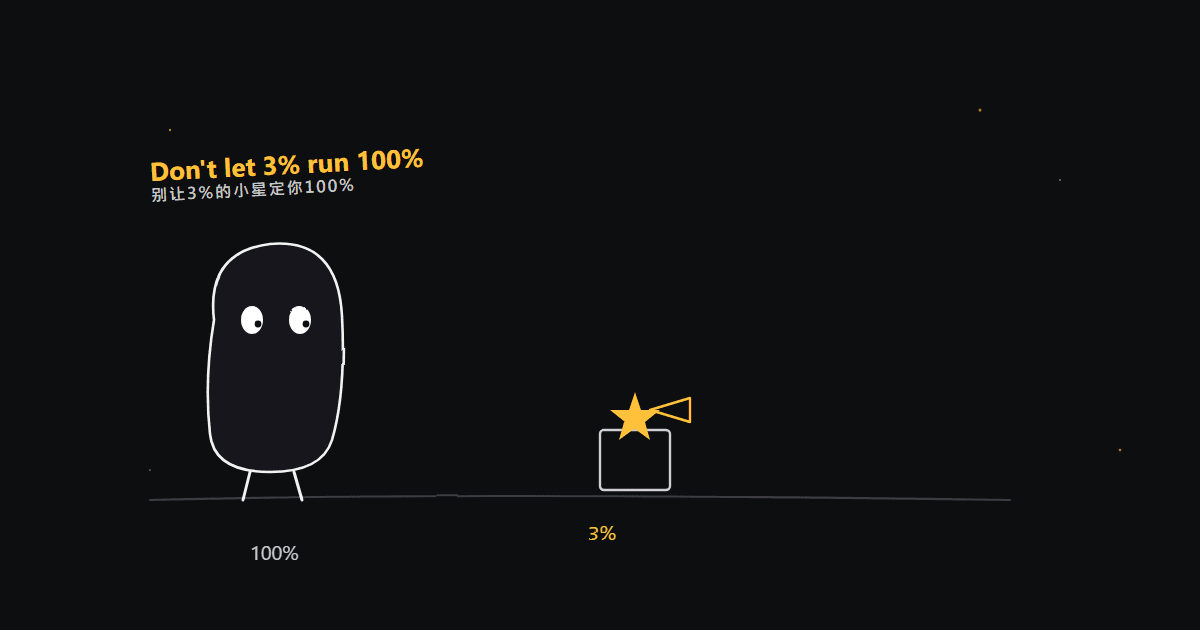
By the third month, I finally registered something. A star with less than 3% weight had scared me for an entire month.
That experience became a permanent reminder in my ziwei studies. It taught me the single most-abused concept in this entire system, which is star weight.
Let me unpack.
Ziwei dou shu has roughly 108 stars total. Don't be alarmed by the number. The 108 are not equal. They have explicit tiered weight.
At the top sit the fourteen main stars. Ziwei, 天机, 太阳, 武曲, 天同, 廉贞, 天府, 太阴, 贪狼, 巨门, 天相, 天梁, 七杀, 破军. These fourteen genuinely determine the structure of your chart. Their combined weight covers more than 70% of judgment.
In the middle sit eight auxiliary stars. 左辅, 右弼, 文昌, 文曲, 天魁, 天钺, 禄存, 天马. These amplify or moderate the main stars but cannot set the tone alone. Combined weight around 20%.
At the bottom sit dozens of minor stars and "spiritual influences" — 天刑, 红鸾, 天喜, 孤辰, 寡宿, 大耗, 龙池, 凤阁, and so on. Each of these individually carries less than 5% weight. Some less than 2%.
So when that astrologer told me "天刑 → blood calamity", what was actually happening.
A star with less than 3% weight was being used to issue a prediction of maximum severity for the entire chart. The math doesn't work. It's like one peppercorn deciding whether the soup is sweet or salty.
Why did I believe him. Because I didn't know the weighting. The astrologer never mentions weighting. They give you the star name and the effect. You hear "blood calamity" and you latch on, because fear latches you.
This is one of the most-used tricks in street astrology. The technique is called "cherry-pick the scariest minor star."
Why minor stars. Because main stars are descriptively temperate. Ziwei is "stable and authoritative." 太阴 is "introspective and gentle." None of these sound scary, none of them keep you coming back. Minor star names carry vivid visual punch. 天刑 sounds bloody. 大耗 sounds like ruin. 孤辰寡宿 sounds like lifelong loneliness. These names are themselves intimidation devices.
Think about it. If an astrologer says "your 命宫 contains 紫微", you don't react. The name isn't scary. But "your 命宫 has 天刑 and your 疾厄宫 has 大耗", you tighten. Yet the combined weight of those two stars might be less than one-tenth of your real 紫微.
This is exactly why the first thing I built into FateStar's engine wasn't more stars. It was explicit weight tagging for every star.
In our engine, every star has two attributes. One is "star nature" (星性). One is "star weight" (星值).
Star nature is the direction of the star. 天刑 is "execution sharpness + legalistic instinct + cutting clarity." That's its semantic meaning.
Star weight is how much of a say the star has in overall judgment. 天刑's weight is roughly 2.5%. That's how much voice it gets.
Both attributes must exist together. Without weight, every star is either irrelevant fluff or a noise bomb.
Let me make this concrete. Suppose a user has 紫微 in 命宫 (main star, weight 7%), plus 天刑 in 命宫 (minor star, weight 2.5%), plus annual 化忌 entering 命宫 (annual-level event, weight 5%).
A traditional astrologer, 99% of the time, leads with 天刑. Why. Because 天刑 sounds scariest.
But unpack the math. 紫微's weight is 2.8x 天刑's. The annual 化忌's weight is 2x 天刑's. The actual drivers of this year for this user are 紫微 (stability requires you to lead) and the annual 化忌 (your dominant theme is blocked). 天刑 isn't a driver. It's a flavor.
Correct interpretation reads more like this. Your central theme this year is staying in your usual leadership position while a major theme blocks you. You naturally possess execution sharpness (the 天刑 layer), which means you should use that sharpness to dissect the block, not to flee from it.
Compare that to "you're going to have a bloody year." Strategy versus panic. The information density is ten times higher.
After 300+ charts I finally got it. The reason ziwei dou shu survived a thousand years isn't that it's accurate. It's that the system has weight tiering. The actual masters of ziwei in classical times read charts top-down. Big picture (格局) first, then main stars, then auxiliaries, then minor stars and influences. Coarse to fine.
This tiering broke down in the nineteenth and twentieth centuries when street astrology dominated. Street astrologers needed dramatic language to retain clients. So they amplified the minor stars dozens of times above their natural weight. Over time, the public came to associate ziwei with "天刑 = blood calamity, 红鸾 = romance arriving, 大耗 = financial ruin" — extreme simplifications that are barely related to actual ziwei interpretation.
That's collective degeneration.
What we're doing at FateStar with the AI engine is reversing that degeneration. Putting each star back in its proper weight tier. Letting main stars speak about big themes. Letting auxiliaries handle nuance. Letting minor stars provide texture only. Three layers stacked correctly is what real ziwei looks like.
AI is structurally better at this than human astrologers. Because AI doesn't need dramatic language to retain customers. AI doesn't need to scare you so you'll come back. AI just needs to present the data at correct weight. That's its whole job.
In our engine, no minor star with less than 5% weight is allowed to drive a primary judgment. Minor stars only appear as modifiers within main-star interpretations. That's a hard rule.
I'll close with a heavy real example, so you understand what weight mis-allocation actually costs.
A friend had a reading in 2019. The astrologer said, your 夫妻宫 has a bright 红鸾, your soulmate is here this year. She happened to be dating someone who wasn't really right for her. With one foot in and one foot out, she heard "红鸾 is here, so this must be the one." She married him that year.
红鸾's weight is below 5%. But her 夫妻宫's actual main star was 太阴化忌. Which means her real energetic theme in relationships was internal erosion, not soulmate arrival.
The astrologer never mentioned 太阴化忌. Because 太阴化忌 isn't dramatic. Just 红鸾, because 红鸾 sells.
She divorced two years later. Came back to me to talk about it. I looked at the original chart. My stomach dropped. The cost was two years of her youth and a non-trivial divorce expense.
I told her, this isn't astrology's fault. This is the fault of astrologers who don't talk about weight.
She was quiet for a long time. Then she said, Louis, if I'd known about weight back then, that single star wouldn't have fooled me.
Most people don't know about weight. So here's a single question you can ask any future astrologer.
"How much weight does this star carry in my overall chart."
99% of street astrologers cannot answer. They've never thought about weight as a concept. They memorized a list of star names and their scariest associated phrases.
Anyone who can answer is the kind of astrologer worth listening to.
Ziwei dou shu, after the AI-era cleansing, has a chance to return to what it actually is. A clearly structured system with explicit weights, useful for decisions, not for manufacturing fear.
If a minor star has ever scared you, look at your chart again today. This time, you'll see the actual structure instead of amplified noise.
Read your chart with correct weight on FateStar →
FAQ
Does Chinese astrology say my personality decides my destiny?
Not the way a single scary star suggests. A reading is weighted: the fourteen main stars carry most of the meaning, while minor stars only add texture. Your dominant patterns shape tendencies, not a fixed verdict. It's closer to a window into likely themes than a sentence you must serve.
Fate vs free will — which one does ziwei dou shu actually support?
Read correctly, it leans toward free will. The chart maps your starting energy and recurring themes, but the heavy weight tiering exists so you can see structure and make decisions. Used as fear theater, it pretends to lock your fate. Used as a map, it hands you back the steering wheel.
How do I avoid being scared by one minor star in a reading?
Ask the astrologer a single question: "How much weight does this star carry in my overall chart?" A genuine reader can place it among main, auxiliary, and minor tiers. If they can't, they're likely cherry-picking the scariest name — and you can own your life instead of bowing to a 3% influence.
What the classics say
The Complete Book of Zi Wei Dou Shu (Ming dynasty) says: "When the stars are favorable, even misfortune turns favorable; when unfavorable, even fortune turns against you." In this article's context: the ancients settled this centuries ago - no single star decides a chart; combinations are everything. Letting one 3%-weight minor star scare you is precisely the reading the classics reject.
Disclaimer: This article is cultural commentary on Zi Wei Dou Shu, for self-reflection and entertainment only - not medical, legal, financial, or any professional advice.
⚠️ FateStar generates and interprets your chart based on the traditional Chinese discipline of Zi Wei Dou Shu (紫微斗数). All content is for informational and reflective purposes only.
About the Author

Founder of FateStar. He began structured study of San He Zi Wei Dou Shu in 2020 and is responsible for product method, source organization, and content review. Personal experience is not presented as scientific proof.
More about Louis →