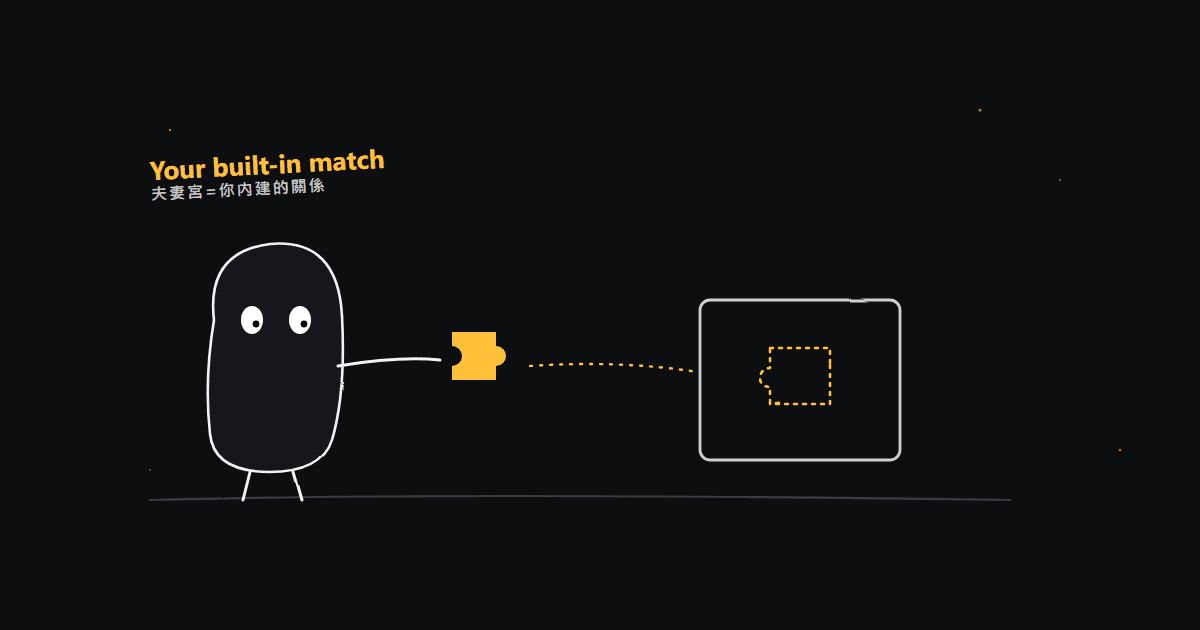
A Career Palace (官禄宫) with no main star does not mean a bad career. An empty palace is read through the two main stars in the palace opposite it, the Spouse Palace (夫妻宫). Then you combine that with the Life Palace (命宫), the Wealth Palace (财帛宫) and the Four Transformations to judge where your work is heading.
First, let's be clear about what an empty palace is. Zi Wei Dou Shu has fourteen main stars, and they have to be placed into twelve palaces. Some palaces get two, and some get none. A palace that no main star falls into is called an empty palace. An empty palace isn't actually bare. Supporting and minor stars can still show up there: Zuo Fu and You Bi (左辅右弼, the Left Assistant and Right Helper), Wen Chang and Wen Qu (文昌文曲, the two Literary stars), Lu Cun (禄存, the Salary star), Qing Yang and Tuo Luo (擎羊陀罗, the Ram and the Spinning Top), and Huo Xing and Ling Xing (火星铃星, the Fire and Bell stars). What it lacks is only a main star. The main star is the backbone of a palace and sets its basic character. Without that backbone, you have to look elsewhere when you read it.
So how many empty palaces does a chart have? That depends entirely on which palace Zi Wei (紫微, the Emperor star) falls in. Zi Wei's position comes from your lunar birth day and your Five Elements bureau. Once Zi Wei is placed, the other thirteen main stars are laid out at fixed distances from it, and not one of them can move. If Zi Wei sits in Yin or Shen (two of the twelve earthly branches), Zi Wei shares a palace with Tian Fu (天府, the Treasury star), and Lian Zhen (廉贞, the Integrity star) shares a palace with Tian Xiang (天相, the Minister star). The fourteen stars fill all twelve palaces exactly, and the whole chart has no empty palace. If Zi Wei sits in Si or Hai, four palaces are left empty. With Zi Wei in Si, the empty ones are Wu, Wei, Shen and Xu. With Zi Wei in Hai, they are Zi, Chou, Yin and Chen. For the remaining eight positions, Zi, Chou, Mao, Chen, Wu, Wei, You and Xu, two palaces are empty each time.
Curious about your own chart? Cast it free in 30 seconds →
So empty palaces come naturally out of the structure of chart casting. They have nothing to do with whether a destiny is good or bad. Wherever Zi Wei lands, the empty palaces follow. People born in the same two-hour period have the same natal chart, and their empty palaces sit in the same places. An empty palace only tells you that the stars in that chart are distributed this way. It is neither lucky nor unlucky.
Next, let's look at the Career Palace's neighbors. The twelve palaces run in this order: Life, Siblings (兄弟宫), Spouse, Children (子女宫), Wealth, Health (疾厄宫), Travel (迁移宫), Friends (交友宫), Career, Property (田宅宫), Fortune (福德宫, the palace of inner wellbeing) and Parents (父母宫). The Career Palace and the Spouse Palace are six palaces apart and sit directly facing each other, so the Spouse Palace is the Career Palace's opposite palace. The Career Palace also forms a triangle with the Life Palace and the Wealth Palace, called the trine. The opposite palace plus the two trine palaces, plus the palace itself, make up the Career Palace's "three directions and four squares" (三方四正). When an empty palace borrows stars, it borrows from the palace directly opposite. The stars in the trine palaces also shine across, just along a different route. Why borrow from the opposite palace first? The opposite palace faces this one head on, so the stars in the two palaces shine directly on each other. The trine palaces shine in at an angle, one step removed. When a palace has no backbone of its own, the most direct reference is the two stars across from it. So when borrowing stars, look at the opposite palace first, and bring in the trine palaces afterward to read together.
The table below lists where the Career Palace's three directions and four squares fall for each branch your Life Palace might be in. Just check it against your own chart.
| Life Palace | Career Palace | Opposite: Spouse Palace | Trine: Wealth Palace |
|---|---|---|---|
| Zi | Chen | Xu | Shen |
| Chou | Si | Hai | You |
| Yin | Wu | Zi | Xu |
| Mao | Wei | Chou | Hai |
| Chen | Shen | Yin | Zi |
| Si | You | Mao | Chou |
| Wu | Xu | Chen | Yin |
| Wei | Hai | Si | Mao |
| Shen | Zi | Wu | Chen |
| You | Chou | Wei | Si |
| Xu | Yin | Shen | Wu |
| Hai | Mao | You | Wei |
With the positions clear, here is a conclusion you can only reach if you know how to cast a chart. If you work through all twelve possible positions of Zi Wei one by one, every empty palace has two main stars sitting opposite it. No exceptions. You will never find a single main star across from an empty palace, let alone another empty palace. Applied to the Career Palace: when the Career Palace is empty, the Spouse Palace is always a two-star palace. This is very practical. When you see an empty Career Palace, you can look across and know there will be two stars waiting for you to read. An empty Life Palace follows exactly the same rule. If you want to see how that works out, read the article on a Life Palace with no main star.
So which two stars will the Spouse Palace hold? The range is actually very narrow. Working from Zi Wei's twelve positions, when the Career Palace is empty, the Spouse Palace can only be one of the twelve pairs below.
| Spouse Palace pair | Star tendencies |
|---|---|
| Tian Tong (天同, the Harmony star) and Ju Men (巨门, the Great Gate star) | Emotionally sensitive, good at communicating, tends to go back and forth weighing things |
| Tai Yang (太阳, the Sun) and Tian Liang (天梁, the Shelter star) | Looks after people, principled, suited to work with a public dimension |
| Tian Tong and Tian Liang | Gentle, leans toward service and care |
| Lian Zhen and Tan Lang (贪狼, the Greedy Wolf star) | Strong social skills, wide interests, lots of change |
| Tian Ji (天机, the Strategist star) and Tai Yin (太阴, the Moon) | Detail-minded, good at planning and behind-the-scenes organizing |
| Zi Wei and Tan Lang | Wants to lead, with talents in many areas |
| Tai Yang and Tai Yin | One active, one still; an outer rhythm and an inner rhythm side by side |
| Tian Ji and Ju Men | Strong reasoning, good at analysis and expression |
| Tian Tong and Tai Yin | Soft, values feelings, prefers a stable environment |
| Wu Qu (武曲, the Wealth star) and Tan Lang | Sensitive to money, leans toward finance and business development |
| Tai Yang and Ju Men | Good speaker, suited to public settings and explaining things |
| Tian Ji and Tian Liang | Leans toward specialist knowledge, consulting, planning |
Look over this table and a few interesting things stand out. Four stars, Tian Fu, Tian Xiang, Qi Sha (七杀, the Seven Killings star) and Po Jun (破军, the Army Breaker star), never appear in a borrowed pair. People with an empty Career Palace cannot borrow these four stars. Zi Wei, Lian Zhen and Wu Qu do appear, but only alongside Tan Lang, as Zi Wei with Tan Lang, Lian Zhen with Tan Lang, and Wu Qu with Tan Lang. Every other pair is made of two of these six stars: Tian Tong, Tian Ji, Tai Yang, Tai Yin, Ju Men and Tian Liang. This list comes straight from the chart-casting rules. It isn't based on statistics, and it doesn't need to be. It also works in reverse. If you see Tian Fu, Tian Xiang, Qi Sha or Po Jun in your Spouse Palace, or only one main star there, then your Career Palace cannot be empty. You can use this to check whether you've misread your chart. People with Zi Wei in Yin or Shen have no empty palaces at all, so their Career Palace always has a main star and this method doesn't apply to them.
Once you know which two stars you're borrowing, the next step is reading them. The method is simple. Use the nature of the two Spouse Palace stars to describe how you work and the settings that suit you. Take Tai Yang with Ju Men. Tai Yang is outgoing, Ju Men is about speech, and together they point toward speaking, explaining and public settings. Work that requires you to talk, such as teaching, sales, hosting and media, fits this pair's character fairly well. With Tian Ji and Tian Liang, Tian Ji rules thinking and Tian Liang rules protection and principle, so the pair leans toward specialist work, consulting and planning, a path where you make a living from knowledge and judgment. With Wu Qu and Tan Lang, Wu Qu is a wealth star and Tan Lang rules desire and socializing, so the pair leans toward finance and business, sensitive to both numbers and opportunities. These are all tendencies of the stars. They help you see a direction, but you can't use them to make definite pronouncements. If you want to compare how to read a Career Palace that does have a main star, see the article on Tian Ji in the Career Palace. Put the two approaches side by side and the difference becomes very clear.
Still, borrowed stars are not the same as stars sitting in your own palace. Their strength is discounted. The character of the stars is still there, just less solid and less direct. In a career, this commonly shows up as performance that depends quite a bit on the outside environment. With a good team, a good boss or good partners, you can do very well. When the environment changes, your state may change with it. There's a lot of flexibility, and direction is easier to adjust. Some people change careers partway through, and some do several things at once. That is exactly what an empty palace is like. With no fixed backbone inside, it can more easily go along with outside conditions. Looking back on your own experience, ask whether your working state tends to rise and fall with your team and surroundings. If it matches, reading through borrowed stars fits you well. If it doesn't quite match, pay more attention to the Life Palace and the Wealth Palace.
An empty palace is also open space.
Of course, looking at the Career Palace alone isn't enough. As mentioned earlier, the Career Palace has two trine palaces, the Life Palace and the Wealth Palace. Their main stars shine into the Career Palace too, and they carry just as much weight. The Life Palace is your basic makeup, and most of your attitude and habits at work come from there. The Wealth Palace shows how you earn and spend money. Work can't be separated from either of these. So to judge a career, read the Career, Spouse, Life and Wealth palaces together. The Spouse Palace gives you a rough style, the Life Palace tells you who is doing the work, and the Wealth Palace tells you how that work turns into income. Only when several palaces are layered together do you get a complete picture of a career.
Beyond that, you look at the Four Transformations. These are Hua Lu (化禄, the Prosperity transformation), Hua Quan (化权, the Power transformation), Hua Ke (化科, the Fame transformation) and Hua Ji (化忌, the Obstacle transformation). Which stars they land on is set by the heavenly stem of your birth year. An empty palace has no main star, so the birth-year transformations of the main stars won't land directly in it. To find them, look at the two stars in the Spouse Palace, along with the main stars of the Life and Wealth palaces. Take a Geng year as an example. This site uses the San He (三合) school, in which the Geng stem gives Tai Yang Hua Lu, Wu Qu Hua Quan, Tian Tong Hua Ke and Tai Yin Hua Ji. If you were born in a Geng year with an empty Career Palace, and your Spouse Palace happens to be a pair containing one of these stars, pay special attention. If the Spouse Palace is Tai Yang with Ju Men or Tai Yang with Tian Liang, the borrowed Tai Yang carries Hua Lu. If it's Wu Qu with Tan Lang, Wu Qu carries Hua Quan. If it's Tian Tong with Ju Men or Tian Tong with Tian Liang, Tian Tong carries Hua Ke. If it's Tian Ji with Tai Yin, Tai Yin carries Hua Ji. If Tai Yang and Tai Yin share the palace, Lu and Ji appear together. If Tian Tong and Tai Yin share the palace, Ke and Ji appear together. All of these change the flavor of the borrowed stars, and you need to factor them in when reading. If you're not yet familiar with the Four Transformations, start with what the Four Transformations are to get the basics.
After the main stars and the transformations, there's what's already inside the empty palace. An empty palace has no main star, but it often isn't completely starless. If Zuo Fu and You Bi, Wen Chang and Wen Qu, or Lu Cun fall in the Career Palace, they directly affect how the palace plays out. Zuo Fu and You Bi lean toward support and helpful people, Wen Chang and Wen Qu toward paperwork and talent, and Lu Cun toward steady income. On the other hand, if Qing Yang and Tuo Luo or Huo Xing and Ling Xing land there, they bring friction, delays or impatience. When no main star is present, the voices of these supporting and troublesome stars are actually easier to hear. So read them together with the stars borrowed from the Spouse Palace. The borrowed stars give direction, and the supporting and troublesome stars inside give texture. There are exceptions. If the empty palace has many supporting and troublesome stars, busier than the borrowed stars across the way, shift your focus toward what's inside the palace. Conversely, if the empty palace has no stars at all, the borrowed stars and the trine palaces are your main clues.
There's one more thing many people notice. The Career Palace borrows from the Spouse Palace, and the Spouse Palace likewise sees the Career Palace side. The two palaces shine on each other. People with this kind of chart often find that career and partner pull on each other quite noticeably. Some adjust the pace of their work because of their other half, some run a business with their partner, and some throw themselves into working partnerships, so that when the partner changes, their working state changes too. The Spouse Palace here isn't only about marriage. It can extend to long-term business partners. These are all tendencies. Every chart also depends on how the other palaces work with it, so you can't sum it up in one sentence.
At this point, a word about myself. In 2020 I went to Taiwan to study Zi Wei Dou Shu with a teacher, and this is my sixth year. My original reason for learning it was to debunk it. I wanted to see whether the system actually made any sense, and I was proven wrong. Over these years I've read more than 300 charts for people for free, and eventually I just wrote the whole chart-casting logic into a program, which is now FateStar. Actually writing the code forced me to spell out every rule: where Zi Wei falls, how the other thirteen main stars are laid out, and which palaces end up empty. Only after writing the program did I see clearly that how many empty palaces a chart has is decided entirely by Zi Wei's position. The fact that an empty palace always has two stars opposite was also something I verified case by case at that time. Knowing which pairs can be borrowed and which stars can't makes me much more confident when reading a chart.
So how do you read your own chart? Just follow four steps.
Step one: find the Career Palace. First confirm which branch your Life Palace is in, then check the table above to find your Career Palace. Some chart software labels the Career Palace as the "Work Palace" (事业宫); it's the same palace. Confirm your birth time first. If the two-hour period changes, the Life Palace moves, and the Career Palace moves with it.
Step two: check whether the Career Palace has a main star. If none of the fourteen main stars is there, it's an empty palace. Note down any supporting or minor stars. Only the fourteen main stars count here. No matter how many stars like Zuo Fu, You Bi, Wen Chang or Wen Qu are present, they aren't main stars, and the palace is still empty.
Step three: look at the pair in the opposite Spouse Palace. Check it against the table of twelve pairs, see which one you've borrowed, and use the stars' natures to describe your working style. If there aren't two stars opposite, or if Tian Fu, Tian Xiang, Qi Sha or Po Jun appears, go back and check; you may have found the wrong Career Palace.
Step four: look at the Life Palace, Wealth Palace and Four Transformations. What are the main stars of the Life and Wealth palaces? Do the two Spouse Palace stars carry Hua Lu, Hua Quan, Hua Ke or Hua Ji? How do the supporting and troublesome stars in the Career Palace fit in? For the transformations, start with the heavenly stem of your birth year, then find which palaces those four stars fall in. Read all of these together and the outline of your career will emerge.
These four steps need an accurately cast chart. If you don't have one handy, you can cast a free chart for yourself first, find your Career Palace, and see whether it's empty and which two stars it borrows from across the way.
⚠️ FateStar generates and interprets your chart based on the traditional Chinese discipline of Zi Wei Dou Shu (紫微斗数). All content is for informational and reflective purposes only.
About the Author

Founder of FateStar. He began structured study of San He Zi Wei Dou Shu in 2020 and is responsible for product method, source organization, and content review. Personal experience is not presented as scientific proof.
More about Louis →Related Articles
Should I Quit My Job? Your Career Palace in Zi Wei Dou Shu Has a More Honest Answer
How Do You Calculate the Five Element Bureau in Zi Wei Dou Shu?
What Does Qi Sha in the Travel Palace Mean in Zi Wei Dou Shu?
The Anxious Woman's Ziwei Self-Rescue — What Your Health and Happiness Palaces Reveal About Your Insomnia, Binge Eating, and Random Meltdowns
How common is an empty Life Palace in Zi Wei Dou Shu?