Fortune Telling Is the Answer, Not Navigation — Should You Cross the 30 Threshold?
There's a sentence I really dislike hearing.
"Teacher, what you said last time was so accurate. It actually happened."
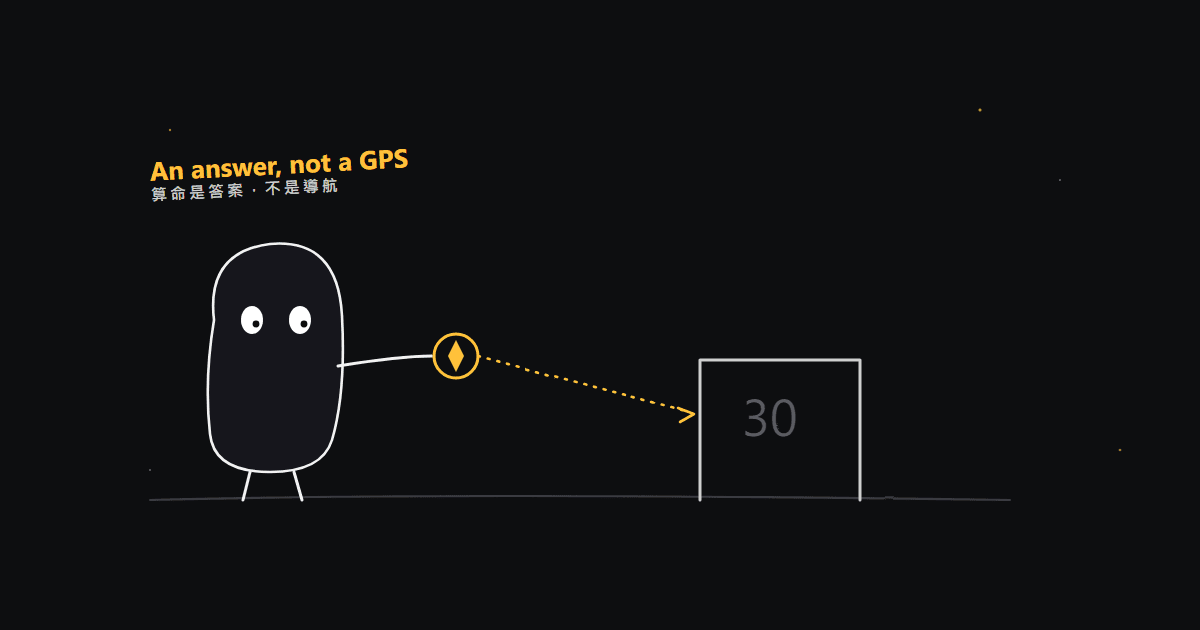
Every time I hear it my stomach drops a little. Not because it's a bad thing to say. Because there's a mindset hidden behind it that I want to push back on. I call it the verification mindset, and it quietly asks the wrong question of fortune telling. People want to know is fortune telling real — but the better question, especially when you're weighing your life direction at 30, is whether it helps you act. That single shift turns the whole thing upside down.
Curious about your own chart? Cast it free in 30 seconds →
Let me unpack.
The verification logic runs like this. Sometime last year you went to an astrologer. They predicted something for a specific month this year. That month came, the thing happened, your stomach did a little flip. You walked away thinking, this astrologer is real, astrology is real, I'll be back next time.
Sounds good, right. Client happy, astrologer validated. Everyone wins.
Look closer. During the eleven months that the astrologer's prediction wasn't materializing, what did you do. Probably nothing. You waited. You waited for the prediction to come true and confirm itself.
That's the verification trap. It turns fortune telling into passive waiting. Not active strategy.
Think about what astrology is supposed to do. Through thousands of years of evolution, the actual value of the system is to hand you a map when you're at a crossroads. Not to have someone stand at the crossroads and yell, go left. A map you can read yourself, judge for yourself, choose for yourself.
The verification mindset reduces you to someone who only knows how to follow shouts.
I've been there. In 2018, just getting serious about ziwei, I did exactly this. I'd visit astrologers, scribble every prediction in a notebook, and wait for them to come true. When one did, I trusted the system more. When one didn't, I told myself, the time isn't right yet.
This lasted about a year. Then over dinner with an older astrologer friend, after listening to my "verification log", he set his chopsticks down and said, Louis, you're using ziwei like tarot. If you keep this up, you'll never actually learn the system.
I was confused. I said, tarot works fine.
He said, tarot pulls a card to read a current moment. Tarot is a question-answer tool by design. Ziwei isn't. Ziwei spreads all your life's possibilities across one map. Using a map as a question-answer tool wastes the map. You should be planning routes, not checking prophecies.
I thought about that conversation for three months. Eventually I understood what he meant.
A ziwei chart doesn't give you a prediction or two. It hands you the structure of your own energy. What you're naturally good at. Where you're prone to stepping wrong. Which slice of your potential gets activated in each life stage. Which themes will dominate this year. That information isn't built for prediction. It's built for decision support.
Imagine a manual that comes with your machine. The manual says, you perform best in dry environments. You're vulnerable to water. After eight hours of high-output operation you need to rest. Your peak power output occurs at a specific temperature. The value of this manual isn't predicting "the day your machine will break." The value is teaching you how to use yourself so you run well and long.
If you read this manual to predict breakdowns, you've misused it. You should read it to inform every small decision you make about how to deploy yourself.
Back to that sentence I dislike.
If you came to me and said "what you predicted was so accurate, it happened", I'd probably reply with a question that flips your stomach.
I'd ask, what did you do to prepare for it.
If you answer "nothing, I just waited", I'd say, then this prediction had zero value for you. You watched a free trailer of your own life. You changed nothing.
If you answer "I adjusted my decision framework, I prepared multiple paths, I paid extra attention to that direction in that month", then I'd consider our reading meaningful.
Fortune telling's value isn't in being accurate. It's in whether it makes your next move smarter.
This sounds counterintuitive until you apply it to other tools.
You use Google Maps. Your goal isn't to verify whether the map is accurate. Your goal is to arrive somewhere. You watch weather forecasts. Your goal isn't to validate the forecaster. Your goal is to decide what to wear today. You read an ECG. Your goal isn't to confirm the doctor's skill. Your goal is to adjust your behavior now.
Why do people flip the function for astrology.
I've thought about this for a long time. Two reasons.
One, astrological output is about the future, and the future carries a mystical aura. That aura tempts people to judge it by miracle standards. You don't judge Google Maps by miracle standards because Maps shows you the present road network. You judge astrology by miracle standards because astrology shows you something that hasn't happened.
This is a misunderstanding. The future ziwei points at isn't miracle. It's trend projection based on your energy structure. It belongs in the same category as weather forecasts. Using known patterns to estimate probability distributions over what's coming.
Two, for centuries street astrologers have been selling prophecies, not strategies. Prophecy outsells strategy. Prophecy only needs to sound impressive. Strategy needs to actually improve your decisions. The bar for the latter is much higher. The result is that markets are flooded with prophecy-sellers, and over generations the public came to equate "visiting an astrologer" with "listening to prophecy."
This is a collective mistake. The more it spreads, the harder it is for real astrological value to surface.
A big part of why I built FateStar is to undo this. I want our users to open the app and instinctively reach not for "tell me what will happen" but for "what's the smartest move on the decision I'm facing now."
These are two completely different product philosophies. The first kind of product gets used once for the novelty, then abandoned. The second kind of product gets used at every life crossroads.
I'm building the second.
In behavioral economics there's a concept called hindsight bias. After something happens, people feel they should have predicted it, even though before the event they had no idea. This bias inflates our self-assessment in retrospect, and it inflates how accurate an astrologer feels to clients after the fact.
A real astrologer should be used in advance. Not consulted retroactively for confirmation.
In advance, you receive strategy. After the fact, you receive performance.
This is the single most important thing I want to say after five years of studying ziwei.
If you're planning to read your chart, no matter whether through our AI or a human astrologer you trust, ask yourself one question first. Why am I going. Is it to confirm a decision I've already locked in, or to study the map before a real crossroads.
If the first, don't go. You've already decided. The reading is a security blanket. Don't spend money for that.
If the second, welcome. We'll spread the map for your year and walk through it. Which road you take is still yours.
See your year's map on FateStar →
FAQ
Is fortune telling real, or just clever guessing?
It depends on what you ask of it. Treated as prophecy, any reading invites doubt. Treated as navigation, a Chinese astrology chart works more like a weather forecast — a trend projection based on your energy structure, not a miracle. It can be uncannily on-point, yet its real value is sharpening your next decision, not proving itself right.
How should I use a chart for my life direction at 30?
Read it before the crossroads, not after. A ziwei chart maps where your strengths sit, where you tend to stumble, and which themes dominate this stage of life. Use that to prepare multiple paths and weigh your options. The chart hands you the map; which road you actually take stays entirely yours.
I keep asking "should I take this path?" — can a reading just tell me?
No honest reading should command you to go left or right. That's the prophecy trap. A good reading lays out the terrain so you choose with clearer eyes: which direction your year tends to favor, what to watch for, where the risks cluster. The decision — and the responsibility for it — remains with you.
What the classics say
The Complete Book of Zi Wei Dou Shu (Ming dynasty) says: "A good chart matters less than a good decade; a good decade matters less than a good year." In this article's context: the ancients ranked timing above the static chart - proof they used astrology as navigation themselves: read the road, pick the moment, never sit waiting for a verdict.
Disclaimer: This article is cultural commentary on Zi Wei Dou Shu, for self-reflection and entertainment only - not medical, legal, financial, or any professional advice.
⚠️ FateStar generates and interprets your chart based on the traditional Chinese discipline of Zi Wei Dou Shu (紫微斗数). All content is for informational and reflective purposes only.
About the Author

Founder of FateStar. He began structured study of San He Zi Wei Dou Shu in 2020 and is responsible for product method, source organization, and content review. Personal experience is not presented as scientific proof.
More about Louis →