Geng Stem Four Transformations Explained: Why Is Huaji Taiyin and Huake Tian Tong in the Three Harmonies School?
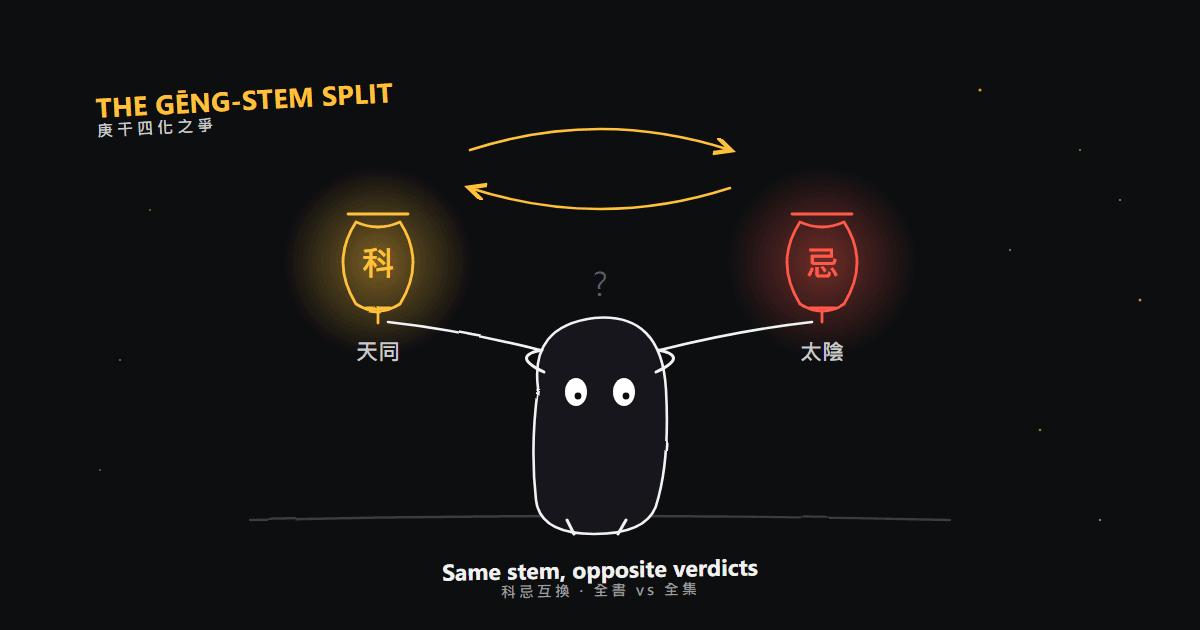
In the Three Harmonies School, the Geng Stem Four Transformations are: Taiyang Huàlù, Wuqu Huàquán, Tian Tong Huàkē, and Taiyin Huàjì. Among them, "Huàkē is Tian Tong, Huàjì is Taiyin" is the arrangement passed down in the Three Harmonies School, which is exactly swapped with the Flying Star School (Huàkē is Taiyin, Huàjì is Tian Tong) — this is why many beginners get confused as soon as they look it up: why do different websites give different results for the Geng Stem Four Transformations?
This article gives the Geng Stem Four Transformations explained in full, focusing on the most puzzling question: Is Huàjì Tian Tong or Taiyin?
What are the four stars in the Geng Stem Four Transformations?
The Heavenly Stem triggers the Four Transformations. The four stars corresponding to the Geng Stem are as follows (Three Harmonies School version):
Curious about your own chart? Cast it free in 30 seconds →
| Transformation | Star | One-line Meaning |
|---|---|---|
| Huàlù | Taiyang | Mainly nobility, giving, male elders; Lù makes it shine and radiate |
| Huàquán | Wuqu | Wealth star takes power; boosts action, decisiveness, and the drive for wealth |
| Huàkē | Tian Tong | Fortune star gains reputation; turns misfortune into blessings, attracts helpful people |
| Huàjì | Taiyin | Wealth/emotion star blocked; money, feelings, mother/wife easily encounter turbulence |
Memory point: The Lù and Quán are the same in both schools (Taiyang, Wuqu); the disagreement is only on Kē and Jì.
Why is Huàjì Taiyin instead of Tian Tong in the Three Harmonies School?
First, the conclusion: This is not about right or wrong; the Geng Stem itself has the greatest divergence among the Ten Heavenly Stems in the Four Transformations, and even ancient texts are not unified.
The main historical arrangements differ (the mnemonic uses the abbreviated star names corresponding to "Lù Quán Kē Jì"):
- Ziping Weizao Quanshu (Chen Xiyi's tradition): Yang Wu Tong Yin — Taiyang Huàlù, Wuqu Huàquán, Tian Tong Huàkē, Taiyin Huàjì
- Ziping Weizao Quanji: Yang Wu Yin Tong — Taiyin Huàkē, Tian Tong Huàjì (Kē and Jì are exactly swapped with Quanshu)
- Zhongzhou School (Wang Tingzhi's lineage): Yang Wu Fu Tong — Tianfu Huàkē
That is, for the same Geng Stem, the Quanshu says "Tian Tong Huàkē, Taiyin Huàjì," the Quanji says the opposite, and the Zhongzhou School replaces it with Tianfu. The Lù (Taiyang) and Quán (Wuqu) are consistent across all three schools; the divergence is entirely in Kē and Jì.
Analogy: the same character, different dictionary editions have different pronunciations — the Kē and Jì of the Geng Stem are the most controversial characters in Ziping Weizao history. No wonder you get mismatched results from different websites.
FateStar adopts the Ziping Weizao Quanshu Chen Xiyi tradition (Tian Tong Huàkē, Taiyin Huàjì), unified across the entire site, not mixed with other schools. Therefore, in the charts you generate at this site, the Geng Stem Huàkē is always Tian Tong, and Huàjì is always Taiyin.
Where exactly does the Geng Stem differ? — Quanshu Version vs Quanji Version
| Transformation | Three Harmonies Quanshu (FateStar) | Quanji / Flying Star School |
|---|---|---|
| Huàlù | Taiyang | Taiyang (same) |
| Huàquán | Wuqu | Wuqu (same) |
| Huàkē | Tian Tong | Taiyin |
| Huàjì | Taiyin | Tian Tong |
Only Kē and Jì differ, but this has a significant impact on chart interpretation: If you are a Geng year native, or your major limit or yearly cycle reaches the Geng Stem, using the wrong version can reverse the auspiciousness or inauspiciousness — where Taiyin receives Jì causing wealth and emotional troubles, the Quanji version would read it as Tian Tong Huàjì. Therefore, before interpreting a chart, confirming which school the chart uses is more important than jumping to conclusions.
What does Taiyin Huàjì represent in a chart?
Taiyin governs wealth, mother and wife, gentleness, and emotions. Taiyin Huàjì often indicates that "the lines of wealth and emotions are prone to tangles":
- In the Wealth Palace: Fluctuations in passive income, savings, and cash flow; conservative financial management is advisable.
- In the Spouse Palace: Emotional sensitivity but prone to overthinking; requires more patience in relationships, especially with the spouse (particularly the wife).
- In the Property / Parents Palace: Likely to have concerns about the relationship with the mother or family harmony.
Huàjì does not equal "bad"; it is more like a magnified lesson that needs attention — knowing where it is tells you where to be more mindful.
What does Tian Tong Huàkē mean?
Tian Tong is the Fortune Star, governing emotional peace and turning misfortune into blessings. Huàkē adds to Tian Tong "reputation and benefactors": difficulties can easily be alleviated, and after danger passes, good reputation remains. When located in the Life, Migration, or Career Palaces, it often indicates a person who is easygoing yet respected, and who receives help from benefactors in times of crisis.
FAQ
Is the Geng stem Hua Ji Tian Tong or Tai Yin?
It depends on the school. In the Three Harmonies (sanhe) school based on the Quanshu, it is Taiyin Huàjì and Tian Tong Huàkē; in the Flying Star school / Quanji, it is the opposite. The two schools swap Kē and Jì, while Lù (Taiyang) and Quán (Wuqu) stay identical. FateStar uses the Quanshu version, so Huàjì is always Taiyin. Always confirm which school your chart uses before reading luck.
Why do different websites give different Geng stem four transformations?
Because they use different school tables underneath. Most charting tools never state whether they follow the Three Harmonies or Flying Star school, so site A shows Huàjì as Tian Tong and site B shows it as Taiyin for the same Geng stem. That is a school difference, not a bug — but a tool mixing inconsistent tables internally is a genuine error. Choose one that locks a single school site-wide.
Which is more accurate, the sanhe school or the Flying Star school?
There is no universally agreed answer. Both the Quanshu and the Quanji are ancient texts circulated for centuries, each holding its own stance on the Geng stem, and neither has been settled. What matters is not the school you pick but self-consistency: the same chart should be read with the same rules throughout. Mixing schools is what produces real misreadings.
Which version does FateStar use?
The Three Harmonies School tradition: Huàkē is Tian Tong, Huàjì is Taiyin. The entire engine is unified and cannot be switched or mixed. To see which palace the Geng Stem Four Transformations fall in your personal chart, you can directly generate your chart on FateStar.
Want to know which palace the Geng Stem Four Transformations fall in your own chart and what events they trigger? Use FateStar to generate your chart for free — the Three Harmonies School Geng Stem (Huàkē Tian Tong, Huàjì Taiyin) is already locked according to the Quanshu ancient text. Input your date and time of birth, and in 30 seconds get a complete chart with Four Transformations annotations.
⚠️ This article is for cultural research and self-exploration only, and does not constitute medical, legal, financial, or other professional advice. 'FateStar' generates 'charts' based on the traditional Chinese culture 'Ziping Weizao' for analysis and reasoning. Content is for reference only.
What the classics say
The Complete Book of Zi Wei Dou Shu (Ming dynasty) says: "When Lu meets a clash, fortune hides misfortune." In this article's context: even transformation tables carry school-level nuance - which is why the Geng-stem difference between San He and Fei Xing lineages matters, and why a reading must declare which table it follows.
⚠️ FateStar generates and interprets your chart based on the traditional Chinese discipline of Zi Wei Dou Shu (紫微斗数). All content is for informational and reflective purposes only.
About the Author
Founder of FateStar. He began structured study of San He Zi Wei Dou Shu in 2020 and is responsible for product method, source organization, and content review. Personal experience is not presented as scientific proof.
More about Louis →