What Is San Fang Si Zheng in Zi Wei Dou Shu? The Four Linked Palaces
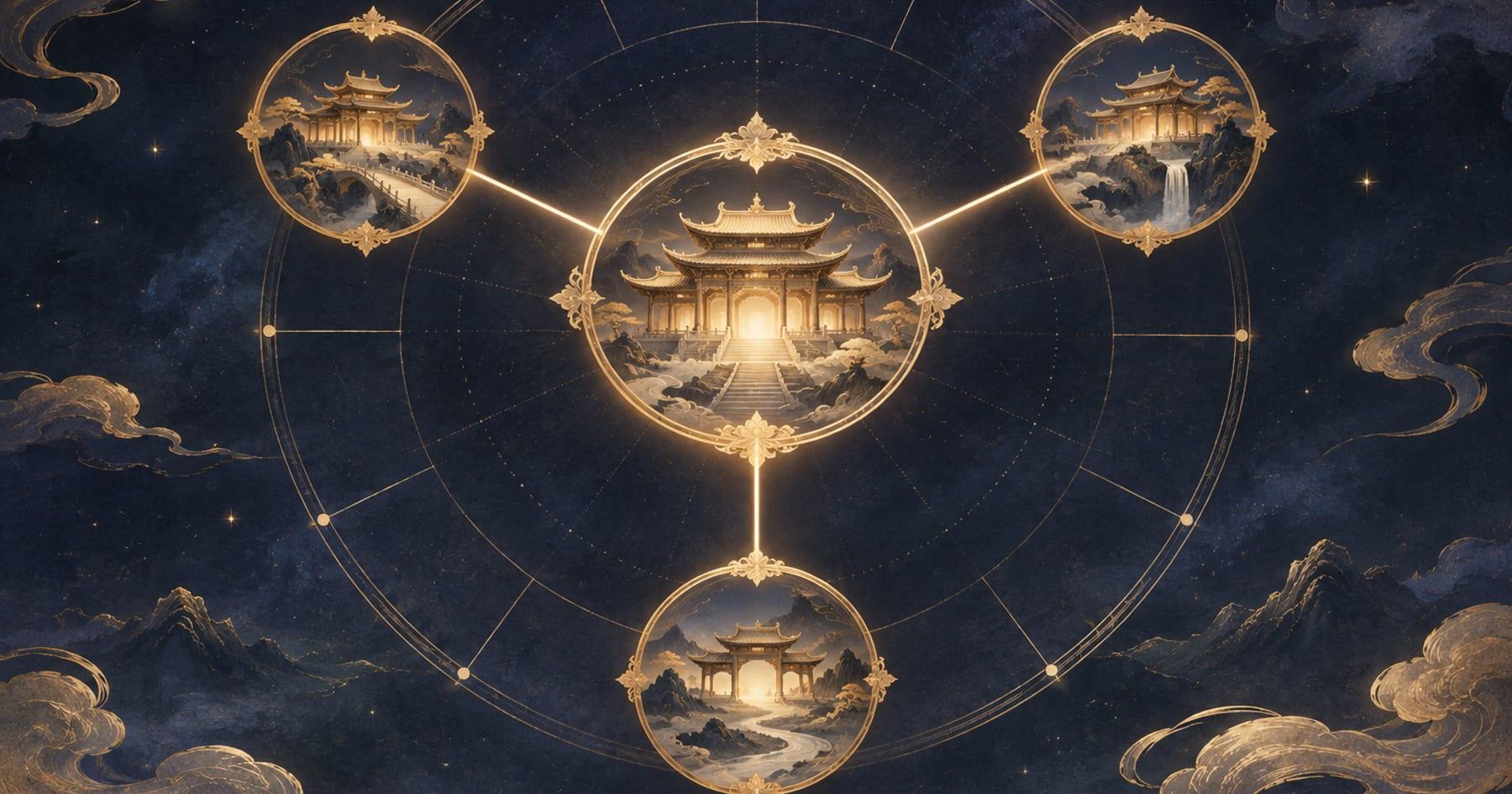
San Fang Si Zheng (三方四正) is the Home Palace (本宫), its two trine palaces (三合宫, sanhe gong, the palaces that form a triangle with it), plus the Opposite Palace (对宫): four palaces in all. To read the Life Palace (命宫), you read the Life Palace, Wealth Palace (财帛宫), Career Palace (官禄宫) and Travel Palace (迁移宫) together. If you stare only at the Life Palace, it is easy to misread.
Start with the words themselves. San Fang (三方, "three directions") means three palaces. The Home Palace counts as one, and the other two are its trine palaces. These three palaces sit four cells apart from each other on the chart. Join them with lines and you get exactly a triangle. Si Zheng (四正, "four true positions") adds the Opposite Palace on top of those three. The Opposite Palace is the cell directly across, six cells away from the Home Palace. Why four and six? Split twelve cells evenly into three parts of four cells each, and the three points stand as an equilateral triangle. Fold the twelve cells in half, six on each side, and the two ends of the crease are a pair of opposite palaces. The twelve palaces form a ring, and the cell across from you is the farthest away, yet it shines on you most directly. A triangle plus a straight line, and all four palaces are in place. The name is easy enough to understand, but how are these four palaces actually determined? For that we have to start with how the twelve palaces are laid out.
The twelve palaces start from the Life Palace and run counterclockwise, one cell at a time. The order is Life Palace, Siblings Palace (兄弟宫, Xiongdi, brothers and sisters), Spouse Palace (夫妻宫), Children Palace (子女宫, Zinü, children), Wealth Palace, Health Palace (疾厄宫, Ji'e, illness and health), Travel Palace, Friends Palace (交友宫, Jiaoyou, also called the Servants Palace, 仆役宫, Puyi), Career Palace, Property Palace (田宅宫, Tianzhai, home and property), Fortune & Virtue Palace (福德宫, Fude, inner wellbeing and enjoyment), Parents Palace (父母宫, Fumu, parents). Treat the Life Palace as cell 0 and count onward. Cell 4 is the Wealth Palace. Cell 6 is the Travel Palace. Cell 8 is the Career Palace. Four cells on is the Wealth Palace, eight cells on is the Career Palace, and these two are the Life Palace's trine palaces. Six cells on is the Travel Palace, sitting exactly opposite the Life Palace. So the San Fang Si Zheng of the Life Palace is always the same four: the Life Palace, Wealth Palace, Career Palace and Travel Palace. I turned the whole chart-casting logic into a program, which is what FateStar is today. When I got to this part, the code was surprisingly short. It does only one thing: starting from the Home Palace, take the fourth, sixth and eighth cells onward. No exceptions, and no lookup table.
Curious about your own chart? Cast it free in 30 seconds →
It works the same way once you map it onto the Earthly Branches (地支). Wherever the Life Palace falls, the other three palaces follow from it. The table below shows the matches when the Life Palace falls in each of the twelve Earthly Branches.
| Life Palace | Wealth Palace | Career Palace | Travel Palace |
|---|---|---|---|
| Zi (子) | Shen (申) | Chen (辰) | Wu (午) |
| Chou (丑) | You (酉) | Si (巳) | Wei (未) |
| Yin (寅) | Xu (戌) | Wu (午) | Shen (申) |
| Mao (卯) | Hai (亥) | Wei (未) | You (酉) |
| Chen (辰) | Zi (子) | Shen (申) | Xu (戌) |
| Si (巳) | Chou (丑) | You (酉) | Hai (亥) |
| Wu (午) | Yin (寅) | Xu (戌) | Zi (子) |
| Wei (未) | Mao (卯) | Hai (亥) | Chou (丑) |
| Shen (申) | Chen (辰) | Zi (子) | Yin (寅) |
| You (酉) | Si (巳) | Chou (丑) | Mao (卯) |
| Xu (戌) | Wu (午) | Yin (寅) | Chen (辰) |
| Hai (亥) | Wei (未) | Mao (卯) | Si (巳) |
The Life Palace can fall in twelve places in this table. But look closely at the first three columns and there are only four combinations. Life Palace in Zi, Wealth Palace in Shen, Career Palace in Chen: together that makes Shen-Zi-Chen. Life Palace in Yin, Wealth Palace in Xu, Career Palace in Wu: that is Yin-Wu-Xu. Life Palace in Chou, Wealth Palace in You, Career Palace in Si: that is Si-You-Chou. Life Palace in Mao, Wealth Palace in Hai, Career Palace in Wei: that is Hai-Mao-Wei. These four groups are the Earthly Branch triads (sanhe, 三合, "three harmonies"). Wherever the Life Palace falls, its three palaces can never escape these four triangles. The Opposite Palace is even simpler, with only six pairs: Zi and Wu, Chou and Wei, Yin and Shen, Mao and You, Chen and Xu, Si and Hai. With the Life Palace in Zi, the Travel Palace is in Wu. With the Life Palace in Si, the Travel Palace is in Hai. Learn the four triads and the six opposite pairs by heart, and for any cell you see, you can find its other three palaces right away.
There is one easy place to trip up when counting cells. The Earthly Branches on the chart run clockwise: Zi, Chou, Yin, Mao, all the way round. The twelve palaces, however, run counterclockwise. So when you count palace names onward from the Life Palace, on the Earthly Branches you are counting backward. With the Life Palace in Zi, count back four positions, through Hai, Xu and You, to Shen: that is the Wealth Palace. Count back another four positions to Chen: that is the Career Palace. Every row in the table was worked out this way. When checking it yourself, there is a quick test. The Earthly Branches of the Life Palace, Wealth Palace and Career Palace must form one of the four triads. If they don't, you have miscounted.
From all this, it might sound as if San Fang Si Zheng belongs to the Life Palace alone. In fact any palace can be read this way; the Life Palace is just the one used most often. The rule is the same. Four and eight cells on are the trines, and six cells on is the Opposite Palace. Take the Spouse Palace. Four cells on from the Spouse Palace is the Travel Palace, eight cells on is the Fortune & Virtue Palace, and directly opposite is the Career Palace. So the San Fang Si Zheng of the Spouse Palace is the Spouse Palace, Travel Palace and Fortune & Virtue Palace, plus the Opposite Palace, the Career Palace. When you look at love, you can't look at the Spouse Palace alone. How you are out in the world, what you feel inside and the pressure of your career all shine onto it. Now the Wealth Palace. Four cells on is the Career Palace, eight cells on wraps back to the Life Palace, and opposite is the Fortune & Virtue Palace. The San Fang Si Zheng of the Wealth Palace is the Wealth Palace, Career Palace and Life Palace, plus the Opposite Palace, the Fortune & Virtue Palace. Where your money comes from can't be separated from your personality and your work. And your attitude to spending is tied to the Fortune & Virtue Palace. Counting the same way, the San Fang Si Zheng of the Travel Palace is the Travel Palace, Fortune & Virtue Palace and Spouse Palace, plus the Opposite Palace, the Life Palace. For the Career Palace it is the Career Palace, Life Palace and Wealth Palace, plus the Opposite Palace, the Spouse Palace. When you look at career, the state of the Spouse Palace shines onto it too.
Since every palace has its own San Fang Si Zheng, we may as well sort all twelve palaces into groups in one go. The twelve palaces can be split into four trine groups, or into six opposite pairs. The table below puts the two ways of grouping side by side.
| Trine group | The three palaces | Their Opposite Palaces |
|---|---|---|
| Ming-Cai-Guan (命财官) | Life Palace, Wealth Palace, Career Palace | Travel Palace, Fortune & Virtue Palace, Spouse Palace |
| Xiong-Ji-Tian (兄疾田) | Siblings Palace, Health Palace, Property Palace | Friends Palace, Parents Palace, Children Palace |
| Fu-Qian-Fu (夫迁福) | Spouse Palace, Travel Palace, Fortune & Virtue Palace | Career Palace, Life Palace, Wealth Palace |
| Zi-You-Fu (子友父) | Children Palace, Friends Palace, Parents Palace | Property Palace, Siblings Palace, Health Palace |
The six opposite pairs are: Life Palace and Travel Palace, Siblings Palace and Friends Palace, Spouse Palace and Career Palace, Children Palace and Property Palace, Wealth Palace and Fortune & Virtue Palace, Health Palace and Parents Palace. There is something interesting about this table. The three palaces in the same trine group have exactly the same three palaces in their San Fang. The San Fang of the Life Palace is Ming-Cai-Guan. The San Fang of the Wealth Palace is still Ming-Cai-Guan. So is that of the Career Palace. The only difference between the three is the Opposite Palace. The Life Palace faces the Travel Palace, the Wealth Palace faces the Fortune & Virtue Palace, and the Career Palace faces the Spouse Palace. Look again and you'll also notice that the three Opposite Palaces of the Ming-Cai-Guan group together make up the Fu-Qian-Fu group. Xiong-Ji-Tian and Zi-You-Fu face each other the same way. So when you analyse palaces in the same group, they can share one triangle; just swap out the cell across from them.
That covers the rules. So why must the four palaces be read together? What goes wrong if you look only at the Home Palace? Think of it this way. The stars in the Home Palace are like a person's basic temperament. The trine palaces are the resources in their hands, and also the arena where they get things done. The Opposite Palace is the outside environment, and also how others see them. Look only at the Home Palace and you see only the temperament. What they work with, where they work, how others see them: none of that is visible. When the stars in the Life Palace look strong but the Wealth Palace and Career Palace are weak, the actual result often falls short. They have ideas and drive, but the chips in their hand can't keep up. The reverse holds too. When the stars in the Life Palace are ordinary but the San Fang is powerful, the whole chart can still hold up. The personality seems unremarkable, but with enough resources and a big enough stage, the road still opens up. Put the same star into a different San Fang and the person you read can come out very different.
One cell can't show you a whole person.
The chart-casting rules prove this on their own. Stars already come in groups arranged by San Fang Si Zheng. Take the Tian Fu star group. Starting from Tian Fu (天府), the order is Tian Fu, Tai Yin (太阴), Tan Lang (贪狼), Ju Men (巨门), Tian Xiang (天相), Tian Liang (天梁), Qi Sha (七杀), and then, after skipping three cells, Po Jun (破军). Tan Lang is cell 2 after Tian Fu, Qi Sha is cell 6, and Po Jun is cell 10. The three stars are four cells apart from one another, so they always fall in mutually trine positions. And Qi Sha is exactly cell 6 after Tian Fu, so the Opposite Palace of Qi Sha is always Tian Fu. This follows from the star-placement method of the San He school (三合派, the Three Harmonies school), with no exceptions. So if Qi Sha sits in the Life Palace, its San Fang is bound to meet Po Jun and Tan Lang, and its Opposite Palace is bound to hold Tian Fu. Working the other way, if Po Jun sits in the Life Palace, its San Fang holds Qi Sha and Tan Lang. The same goes for Tan Lang in the Life Palace. The three stars take turns in the seat, and the triangle stays the same. Look only at the Life Palace and you miss the other three stars in this structure entirely. The drive of Qi Sha only shows its full shape when paired with the change of Po Jun and the desire of Tan Lang, plus the steadiness of Tian Fu across the way. These three stars are often called Sha Po Lang (杀破狼, the Qi Sha, Po Jun and Tan Lang trio), and what it takes for them to form a true Pattern (格局) has its own rules; see What Is the Sha Po Lang Pattern?. How Qi Sha and Tian Fu face each other across the Life Palace and Travel Palace is also broken down in What Does Qi Sha in the Travel Palace Mean?. I won't go into Patterns here. The only point is this: the stars are arranged in groups to begin with.
What is true of the stars is true of the Four Transformations (四化) too: they must be read within the San Fang Si Zheng. On this site, the Four Transformations follow the San He school. For the Geng (庚) heavenly stem (tiangan, 天干), the Four Transformations are Tai Yang (太阳) taking Hua Lu (化禄), Wu Qu (武曲) taking Hua Quan (化权), Tian Tong (天同) taking Hua Ke (化科), and Tai Yin taking Hua Ji (化忌). In Zi Wei Dou Shu, the year stem changes on the first day of the first lunar month. Suppose someone is born in a Geng year with Tai Yang in the Career Palace. The Career Palace is a trine palace of the Life Palace, so the Life Palace's San Fang carries that Hua Lu. When you judge the Life Palace, this Hua Lu has to be counted; you can't treat it as if it weren't there. In the same year, Wu Qu takes Hua Quan. If Wu Qu falls in the Travel Palace, it shines into the Life Palace from the Opposite Palace, and it has to be noted too. Likewise, if Hua Ke falls within the Life Palace's San Fang Si Zheng, write it down as well. How to read Hua Ji in whichever palace it lands involves more, so I'll leave that aside for now.
Of the four palaces, the Opposite Palace carries particular weight. The trine palaces shine in from a diagonal; the Opposite Palace shines straight across. The Life Palace and the Travel Palace, one being yourself and the other the outside world, are two sides of the same coin. What you are like at home and what you are like out in the world: you only get the whole picture by reading the two cells facing each other. Other opposite pairs can be read from both ends the same way. Siblings Palace and Friends Palace: on one side your own brothers and sisters, on the other your friends outside. Spouse Palace and Career Palace: one side love, the other career, and the two often pull on each other. When the Life Palace has no main star, the traditional practice is to consult the stars of the Opposite Palace, which also shows how much weight the Opposite Palace carries; the details of the Empty Palace (空宫) are for another article. The earlier example of Qi Sha facing Tian Fu happens to be the clearest case of the Life Palace and Travel Palace mirroring each other.
There is one more fact that follows from the chart-casting rules and has a lot to do with San Fang Si Zheng. The Body Palace (身宫) is set by your two-hour period of birth (shichen, 时辰), and it can only land in six palaces. These periods are named after the Earthly Branches. Born in the Zi hour (子时) or Wu hour (午时), it shares the Life Palace. Born in the Chou hour (丑时) or Wei hour (未时), it is in the Fortune & Virtue Palace. Born in the Yin hour (寅时) or Shen hour (申时), it is in the Career Palace. Born in the Mao hour (卯时) or You hour (酉时), it is in the Travel Palace. Born in the Chen hour (辰时) or Xu hour (戌时), it is in the Wealth Palace. Born in the Si hour (巳时) or Hai hour (亥时), it is in the Spouse Palace. These six palaces are exactly the two trine groups Ming-Cai-Guan and Fu-Qian-Fu. The Life Palace's San Fang Si Zheng, the Life Palace, Wealth Palace, Career Palace and Travel Palace, takes up four of them. The remaining two, the Fortune & Virtue Palace and Spouse Palace, belong to the same trine group as the Travel Palace. So the Body Palace either falls within the Life Palace's San Fang Si Zheng or within the Travel Palace's trine group. It never wanders off to the Siblings Palace, Health Palace, Property Palace or the like. For how to read the Body Palace together with the Life Palace, see How the Life Palace Differs from the Body Palace.
With the reasoning done, you can try it on your own chart. Step one: find the Life Palace. Its position is set by your lunar birth month plus your birth-hour slot, and any chart-casting tool will mark it for you. If the month or the birth-hour slot is off by one, the Life Palace shifts by one cell, and all four palaces change as a set. Step two: from the Life Palace, count four cells onward; that is the Wealth Palace. Count eight cells and that is the Career Palace. The cell directly opposite is the Travel Palace. Count in the same direction the twelve palaces run, following the palace names, and you won't get lost. Most charts are drawn as a square frame. The outer ring has twelve cells, and the four cells in the middle are left blank for basic details. The top row, left to right, is Si, Wu, Wei, Shen; the bottom row, left to right, is Yin, Chou, Zi, Hai. The left column holds Chen and Mao, and the right column holds You and Xu. Zi is at the bottom and Wu at the top, facing each other across the blank middle. The Opposite Palace is the cell straight across, through the middle. Take a Life Palace in Yin. Yin is in the bottom-left corner. Its Opposite Palace, Shen, is in the top-right corner: the Travel Palace. The Wealth Palace is in Xu, in the right column. The Career Palace is in Wu, in the top row. Yin, Wu and Xu join into a triangle, and Yin to Shen is a diagonal straight through the centre of the chart. Step three: take a sheet of paper and draw four columns. Copy out the main stars (zhuxing, 主星), auxiliary stars (fuxing, 辅星) and Four Transformations of the four palaces, one cell at a time. If a cell has no main star, copy it in anyway and mark it as an Empty Palace. Emptiness is information in itself, so don't skip it. Once everything is copied, read it all together; don't draw a conclusion one cell at a time. To read any other palace, use the same method, simply counting cells from that palace. People born in the same two-hour period have the same Natal (本命) chart, and the same San Fang Si Zheng. So confirm the birth-hour slot first. If the chart is cast wrong, no amount of accurate counting will help.
Before you start, here are a few common mistakes. The four palaces are not equal. The Home Palace is primary and the other three are supporting. You can't add up the stars in all four palaces evenly and settle on a score. The stars in the trine palaces and the Opposite Palace also stay in their own palaces. They affect how the Home Palace expresses itself, but they don't move in and become stars of the Home Palace. Some people also mistake neighbouring palaces for the San Fang. The palaces right beside the Life Palace are the Siblings Palace and the Parents Palace. They are the closest, but they are not in the Life Palace's San Fang Si Zheng. The San Fang is about positions four cells apart, not about distance. Also, auspicious stars (jixing, 吉星) in the San Fang don't mean everything will go smoothly. Malefic stars (shaxing, 煞星) in the San Fang don't mean trouble is certain either. San Fang Si Zheng gives you a framework that makes your judgement more complete. The conclusion still depends on how the stars combine with each other.
I started studying under a teacher in Taiwan in 2020, and this year is my sixth year of studying Zi Wei Dou Shu. Over these years I have read more than three hundred charts for people free of charge, and the first step is always the same: put the Life Palace, Wealth Palace, Career Palace and Travel Palace side by side. You can start by casting your own chart with the free chart tool, finding your Life Palace, counting cells as described above, and circling these four palaces.
⚠️ FateStar generates and interprets your chart based on the traditional Chinese discipline of Zi Wei Dou Shu (紫微斗数). All content is for informational and reflective purposes only.
About the Author

Founder of FateStar. He began structured study of San He Zi Wei Dou Shu in 2020 and is responsible for product method, source organization, and content review. Personal experience is not presented as scientific proof.
More about Louis →Related Articles
What Is Zi Wei Dou Shu? A Plain-English Guide to the 12 Palaces, Stars, and Ba Zi Differences

What Does Tian Tong Hua Quan Mean in Zi Wei Dou Shu?
What Does Hua Ji in the Spouse Palace Mean for Your Marriage?
What Does the Health Palace in Zi Wei Dou Shu Say About Your Body?
The Anxious Woman's Ziwei Self-Rescue — What Your Health and Happiness Palaces Reveal About Your Insomnia, Binge Eating, and Random Meltdowns