What Is Zi Wei Dou Shu? A Plain-English Guide to the 12 Palaces, Stars, and Ba Zi Differences
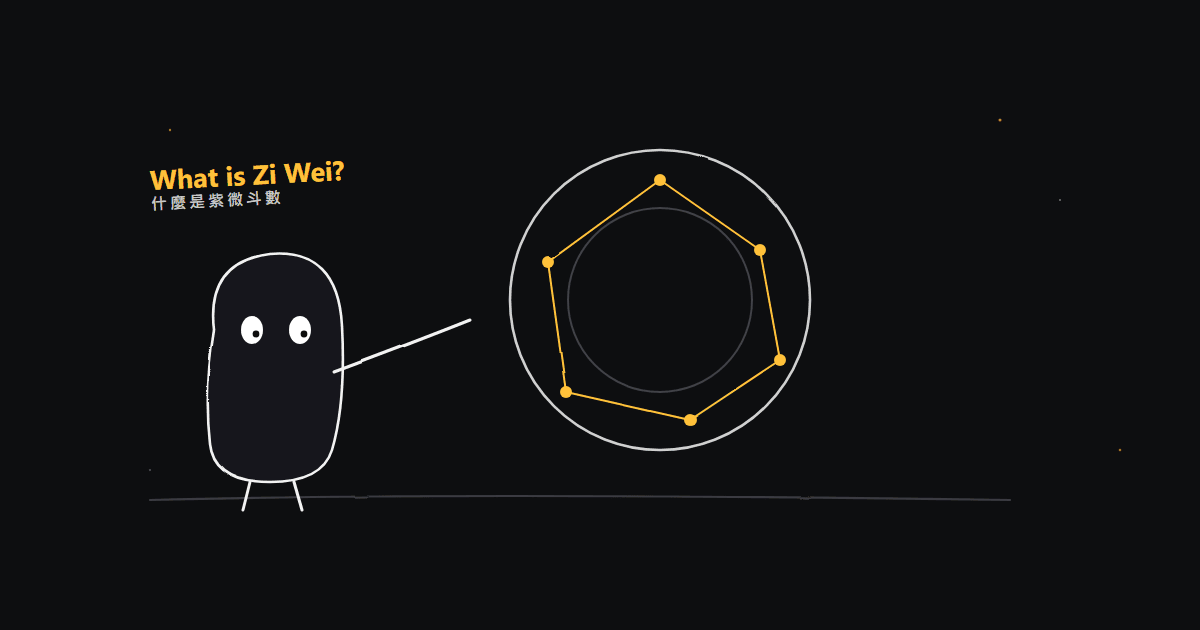
Zi Wei Dou Shu, also called Purple Star Astrology, is a traditional Chinese chart-reading system. It converts a birth year, month, day, and hour into a map of 12 life palaces, 14 main stars, and four transformations. Its clearest difference from Ba Zi is structure: Ba Zi begins with four time pillars, while Zi Wei Dou Shu places symbolic stars into named life areas such as self, relationships, career, wealth, and movement. This guide explains that structure, the major schools, how it differs from Ba Zi, and where an AI-assisted reading can help or mislead. Zi Wei Dou Shu is a cultural framework for reflection, not scientific proof or a guaranteed forecast.
Origins and Schools of Zi Wei Dou Shu
From Chen Xiyi to Three Major Lineages
Zi Wei Dou Shu is traditionally attributed to Chen Xiyi (Chen Tuan, c. 871–989), a Taoist sage of the Five Dynasties and early Song period. The system was elaborated by generations of scholars and crystallized in the Ming dynasty text _Zi Wei Dou Shu Quan Shu_ (Complete Book of Zi Wei Dou Shu, author unknown — the earliest surviving systematic text). The Qing dynasty imperial compendium _Qin Ding Xie Ji Bian Fang Shu_ (Imperially Commissioned Compendium on Harmonizing Times and Distinguishing Directions) later formalized the stellar system within the official calendar framework. The tradition was preserved most completely in Taiwan, Hong Kong, and Fujian, and was reintroduced to the broader Chinese-speaking world in the 1980s through the writings of masters such as Wang Ting-zhi.
I began studying Zi Wei Dou Shu with a teacher in Taiwan in 2020. At first the number of star names felt overwhelming. What kept my attention was the system's structure: each palace has a defined topic, opposite palaces are read together, and the four transformations connect different parts of a chart. That is a personal account of why I continued studying, not statistical evidence that the system predicts life events.
Curious about your own chart? Cast it free in 30 seconds →
The Three Main Schools and What Divides Them
Modern Zi Wei Dou Shu practice centers on three schools, whose core disagreement is how the four transformations (Si Hua) are derived:
| School | Four-Transformation Method | Key Figures | Emphasis |
|---|---|---|---|
| San He (Three Harmony) | Derived from the annual heavenly stem using classical star tables | Chen Xuetao, Zheng Mude lineage | Palace triple-harmony relationships; life pattern analysis |
| Fei Xing (Flying Stars) | Each palace's stem generates its own chain of transformations | Wang Ting-zhi lineage | Dynamic annual reading; event-level prediction |
| Zhong Zhou | Synthesizes both schools into its own framework | Liu Heng lineage | Systematic and academic; complete curriculum |
FateStar uses a documented San He school table as the boundary of its chart engine. For the Geng stem, the product maps Hua Lu to Tai Yang, Hua Quan to Wu Qu, Hua Ke to Tian Tong, and Hua Ji to Tai Yin. Naming the school matters because other lineages can use different tables. This is a consistency choice for calculation, not a claim that every other school is wrong or that the resulting interpretation is scientifically verified.
The 12 Palaces — A Coordinate System for Your Life
If Ba Zi is a timeline (Year Pillar → Month Pillar → Day Pillar → Hour Pillar, flowing from birth to death), Zi Wei Dou Shu is more like a map. This map has 12 cells, each representing a different domain of life.
An analogy: imagine your life as a twelve-room estate. Each room has a designated function. The Life Palace (Ming Gong, the master suite) holds your core character; the Wealth Palace (Cai Bo Gong, the treasury) defines how you earn and accumulate; the Spouse Palace (Fu Qi Gong) shapes the pattern of your intimate relationships. Whichever stars occupy a room determine whether that room is radiant or troubled.
The 12 Palaces at a Glance
| Palace | Core Theme | Opposing Palace |
|---|---|---|
| Life (Ming) | Core personality, outward presence, overall pattern | Travel/Migration |
| Siblings (Xiong Di) | Brothers and sisters, partnerships, peers | Health/Body |
| Spouse (Fu Qi) | Romance, marriage, intimate relationship patterns | Career |
| Children (Zi Nu) | Offspring, creative output, students | Property/Home |
| Wealth (Cai Bo) | How you earn, financial patterns, cash flow | Virtue/Spirit |
| Health (Ji E) | Physical health, body constitution, internal stress | Siblings |
| Travel/Migration (Qian Yi) | Movement, external environments, opportunities abroad | Life |
| Servants/Friends (Nu Pu) | Subordinates, friendships, social circle quality | Parents |
| Career (Guan Lu) | Profession, achievement, public image | Spouse |
| Property (Tian Zhai) | Real estate, home atmosphere, foundational stability | Children |
| Virtue/Spirit (Fu De) | Inner life, enjoyment, sense of fulfillment | Wealth |
| Parents (Fu Mu) | Parental relationships, elders, superiors | Servants/Friends |
These palaces are not isolated — opposing palaces have a constant pull on each other. The Wealth Palace and Virtue Palace face each other: how you make money profoundly affects your inner sense of fulfillment, and vice versa. This dynamic "dialogue between opposing palaces" is the spatial heart of Zi Wei Dou Shu.
The 14 Major Stars and Four Transformations — The Core Algorithm
14 Major Stars
The cast of Zi Wei Dou Shu is 14 major stars, each with a vivid personality archetype:
| Star | Five-Phase Quality | Archetype | Palace Influence |
|---|---|---|---|
| Zi Wei (Purple Star) | Earth (yin) | Leader, emperor, manager | Stabilizing, authoritative, opinionated |
| Tian Ji (Heavenly Machine) | Wood (yin) | Strategist, analyst, advisor | Adaptable, quick-witted, mentally active |
| Tai Yang (Sun) | Fire (yang) | Light source, giver, public figure | Outgoing, generous, easily in the spotlight |
| Wu Qu (Martial Melody) | Metal (yin) | General, executor, CFO | Decisive, pragmatic, results-driven |
| Tian Tong (Heavenly Unity) | Water (yang) | Child, pleasure-seeker, peacemaker | Gentle, passive, needs stability |
| Lian Zhen (Pure Virtue) | Fire (yin) | Lawyer, artist, reformer | Sharp-edged, creative, rule-questioning |
| Tian Fu (Heavenly Storehouse) | Earth (yang) | Warehouse, treasury, conservative | Accumulates, preserves, steady |
| Tai Yin (Moon) | Water (yin) | Moon, sensitive soul, introvert | Delicate, emotional, artistic |
| Tan Lang (Greedy Wolf) | Wood/Water | Desire, charisma, multi-talent | High personal magnetism, strong appetites |
| Ju Men (Giant Gate) | Water (yin) | Debater, skeptic, orator | Persuasive, suspicious, truth-seeking |
| Tian Xiang (Heavenly Minister) | Water (yang) | Assistant, coordinator, seal star | Supportive, norm-following |
| Tian Liang (Heavenly Beam) | Earth (yang) | Parent, doctor, spiritual guide | Protective, authoritative, conservative |
| Qi Sha (Seven Killings) | Metal/Fire | Warrior, reformer, lone wolf | Strong drive, high volatility |
| Po Jun (Breaking Army) | Water (yin) | Destroyer, pioneer, revolutionary | Subversive, innovative, unstable |
The Four Transformations: Fate's Dynamic Modulator
The four transformations (Si Hua) — Hua Lu (化禄, Resources), Hua Quan (化权, Power), Hua Ke (化科, Fame), and Hua Ji (化忌, Obstruction) — are the most sophisticated dynamic mechanism in Zi Wei Dou Shu. Every heavenly stem year (or major period, or annual period palace stem) activates four stars:
- Hua Lu: Flow, incoming resources, open opportunities (a tailwind door swings open)
- Hua Quan: Increased control, rising initiative (a hammer appears in your hand)
- Hua Ke: Reputation, benefactors, examination luck (a spotlight finds you in the crowd)
- Hua Ji: Blockage, obsession, points of financial drain (the door is locked from the other side — the harder you push, the more stuck you get)
Taking the Geng stem in San He school as an example: Hua Lu on the Sun (radiating outward, reputation-based income), Hua Quan on Wu Qu (financial authority and executive power), Hua Ke on Tian Tong (relationship luck, exam fortune), Hua Ji on Tai Yin (subtle drain in emotions and finances). These four stars activate simultaneously, overlaid across your 12-palace map — this dynamic superposition is the engine of annual cycle reading.
Zi Wei Dou Shu vs Ba Zi — 5 Fundamental Differences
This is the question I'm asked most often. Many people who've used Ba Zi feel that Zi Wei Dou Shu is "similar enough." The underlying philosophies are actually quite different.
| Dimension | Zi Wei Dou Shu | Ba Zi (Four Pillars) |
|---|---|---|
| Birth data precision | Requires accurate birth hour (2-hour window per palace); one interval off and the Life Palace shifts entirely | Birth hour precision is relatively less critical; four-pillar data is sparser |
| System orientation | Spatial: 12-palace map, each life domain evaluated independently | Temporal: four pillars, fate flowing along a timeline |
| Output format | Circular or square chart with 14 stars distributed across 12 palaces | Four-column table: year, month, day, hour — 4 stems and 4 branches |
| Interpretive focus | Life patterns, deep character, domain-by-domain analysis | Destiny trajectory, major cycles, five-phase balance |
| AI compatibility | Very high: structured 12-palace format, quantifiable star attributes | Moderate: five-phase generation and control is complex; heavy reliance on oral mnemonics |
What I've Observed in Practice
Across my readings, I've noticed a consistent pattern: Ba Zi tends to have an edge in _timing_ — telling you which years carry which kind of energy — while Zi Wei Dou Shu excels in building a _three-dimensional portrait_ of who a person is and what the structure of each life domain looks like.
To illustrate: when evaluating career potential, Ba Zi might say "when the major cycle reaches a year with strong Officer star, career breakthroughs become more likely." Zi Wei Dou Shu would say "your Career Palace holds Tan Lang with Power transformation — you're naturally suited to work that requires personal charisma and versatile skills, not to staying in one role; moreover, given the state of your Spouse Palace, your career inflection points tend to coincide with relationship transitions." Both perspectives have genuine value. Asking "which one is more accurate?" is the wrong question — it's like asking whether longitude or latitude is more important for navigation.
Where AI Helps ? and Where It Fails
Why Whole-Chart Context Matters
The useful part of a Zi Wei reading is not a label attached to one star. It is the relationship among the Life Palace and its opposite, the connected palaces, the star combination in the Career or Spouse Palace, and the transformations active in the chart. Software can keep those variables visible at once, but deciding whether an interpretation fits a real person still requires context, questions, and the willingness to reject a poor match.
Before 2022, every chart I read for a friend took two to three hours of initial analysis. Beginning in 2023, I noticed something unexpected: large language models handle "structured spatial relationships" remarkably well. The 12 palaces' defined attributes, the 14 stars' personality archetypes, the directional rules of the four transformations — these constitute a clearly-ruled symbolic network, exactly the kind of domain where LLMs excel.
There are three structural reasons Zi Wei Dou Shu is thriving in the AI era:
- Naturally AI-native format: 12 palaces × star qualities × four transformations = a structured data matrix that's far easier to process than the five-phase interaction "feel" of Ba Zi
- Layered interpretive dimensions: character layer, career layer, relationship layer, health layer can be output separately — AI doesn't lose coherence under the information density
- Clear validation pathways: model output can be cross-referenced against past events to form a feedback loop — the foundation of AI-assisted metaphysical research
Two Real Readings (Anonymized)
Case 1: Last year, a 32-year-old senior manager came to me for a reading. Her deepest confusion was: "Why does every promotion I get seem to end a relationship?" Looking at her chart, the Career Palace held Tai Yang (the Sun) with Power transformation, while the Spouse Palace held Tai Yin (the Moon) with Obstruction. The Sun in the Career Palace is a strong exposure star — the more she shines professionally, the more energy she generates in the public sphere. Tai Yin with Obstruction in the Spouse Palace represents a persistent "cloud over the moon" quality in intimate relationships, where the Obstruction transformation's nature is that clinging harder makes things worse. The two stars' energy directions are opposite, and the opposing-palace pull reinforces the pattern: "career high = relationship low" was practically built into her chart's architecture. I told her this wasn't "destined loneliness" — it was a pattern of energy allocation she could actively reshape. That reframe visibly relieved her, because for the first time she could see the structure of the problem, not just feel the pain of it.
Case 2: Similar patterns have appeared in other charts I have read — the specific circumstances always differ, but the underlying energetic architecture shows a striking consistency across cases.
Why Zi Wei Dou Shu Is More AI-Compatible Than Ba Zi
Ba Zi has a structural learning challenge: a large body of mnemonic rules (shen sha, na yin, pattern names) and an irreducible dependence on "feel" transmitted from teacher to student. That kind of tacit knowledge is difficult to formalize in text, and therefore difficult for AI to learn.
The architecture of Zi Wei Dou Shu can be represented as structured data: stars have traditional attributes, palaces have named domains, transformations connect symbols, and timing layers add another frame. That structure makes it easier for software to retrieve the relevant chart facts. It does not mean a language model understands a person's life; the model can still invent sources, overstate certainty, or produce a fluent answer that does not fit the user.
How to Start Learning Zi Wei Dou Shu
A Practical Learning Path
Phase 1: Learn the stars (1–2 months)
Don't rush to read charts yet. First internalize the 14 major stars' personality archetypes. Start with modern texts before returning to classical sources:
- _Zi Wei Dou Shu Bai Hua Xiang Jie_ (Hui Xin Zhai Zhu — "Plain Language Guide," Taiwanese edition; best starting point)
- _Zi Wei Dou Shu Quan Shu_ (Ming dynasty; contains original star descriptions — feel free to skip the dense classical passages and focus on star qualities)
- _Dou Shu Yan Xing_ (Zheng Mude; flagship San He school text; excellent on pattern analysis)
Phase 2: Learn palace relationships (2–3 months)
The opposing, tri-harmony, and six-harmony relationships among the 12 palaces form the spatial logic skeleton of Zi Wei. At this stage, reading your own chart and mapping the principles onto your real life is ten times more effective than abstract study.
Phase 3: Learn the four transformations (3–6 months)
The four transformations are both the hardest and the most rewarding element. Stacking natal Si Hua, major cycle Si Hua, and annual cycle Si Hua requires extensive chart exposure. At this stage, finding a study group or teacher is strongly advisable — solo study without feedback tends to produce confident misunderstanding.
Teacher vs Self-Study vs AI
Find a teacher: fastest progress, but good teachers are rare and tuition isn't cheap. Advantage: corrects directional errors early.
Self-study: suited to people with strong systematic learning habits who can build their own verification frameworks. Risk: mistaking familiarity for understanding.
AI-assisted: suited to people who want to understand their own chart before committing to deeper study. AI can provide structured preliminary readings that help you identify which direction is worth investing in.
The highest-efficiency approach combines all three: use AI to generate and initially interpret your chart, identify your most interesting focal areas, then target your book reading or teacher-seeking accordingly. You can start by getting your complete Zi Wei Dou Shu chart at FateStar — seeing the actual distribution of stars across your 12 palaces tends to make the abstract concepts concrete very quickly.
FAQ
What is Zi Wei Dou Shu, in plain terms?
Zi Wei Dou Shu, often called Purple Star Astrology, is a branch of Chinese astrology that maps your life using your exact birth time. It places 14 major stars across 12 palaces — career, wealth, marriage, family, and more — to describe your character and life patterns. Think of it as a coordinate map of who you are, not a fixed prophecy of what happens.
Zi Wei vs Ba Zi: which should I learn first?
They measure different things, so neither replaces the other. Ba Zi (Four Pillars) reads timing — which years carry which energy. Zi Wei Dou Shu reads structure — who you are and how each life domain is shaped. In my own readings their conclusions tend to reinforce each other. Start with whichever question matters most to you right now: timing, or self-understanding.
What if I don't know my exact birth hour?
Zi Wei Dou Shu is more sensitive to birth hour than Ba Zi — a two-hour gap can shift your Life Palace entirely. If you're unsure, ask family, find your birth certificate, or use chart calibration: match known life events before age 35 against candidate charts to find the best fit. An uncertain hour doesn't make a chart useless; it just calls for more caution with core-palace judgments.
Can AI Zi Wei Dou Shu readings be trusted?
It depends on the engine behind the AI. Many "AI fortune-telling" tools are just general chatbots wrapped in mystical language, running on a flawed chart calculator. A defensible approach separates the steps: a verified algorithm generates the correct chart, then AI interprets it. AI handles interpretation, not computation — that split is what makes an AI reading worth taking seriously.
Closing: Knowing Yourself Is the Oldest and Most Modern Need
The reason I built FateStar is simple: I felt that Zi Wei Dou Shu contains real life insight, but it's been wrapped in so much terminology and mystification that most people never find their way in.
Software now calculates a chart in seconds and can explain unfamiliar symbols in plain language. That lowers the entry barrier, but it also makes confident-sounding mistakes easier to scale. Use AI to organize questions and compare chart relationships; do not use it as proof, diagnosis, or authority over a major life decision.
If you want to inspect your own chart, start with one focused question and compare the interpretation with evidence from your experience. Keep what helps you observe a pattern; discard what relies on fear, flattery, or certainty without support.
Generate your first Zi Wei Dou Shu chart at FateStar →
This article combines traditional source material with the author's interpretation. Personal experience is not statistical proof. Zi Wei Dou Shu is presented as a framework for reflection, not a scientific prediction system, and nothing here is medical, legal, investment, or other professional advice.
References
- _Zi Wei Dou Shu Quan Shu_ (Ming dynasty transmission, author unknown)
- _Qin Ding Xie Ji Bian Fang Shu_ (Imperially commissioned, Qianlong reign, Qing dynasty, vol. 32: Stellar Systems)
- Zheng Mude, _Dou Shu Yan Xing_ (Taipei: Wu Ling Press)
- Hui Xin Zhai Zhu, _Zi Wei Dou Shu Bai Hua Xiang Jie_ (Taiwanese edition)
- Wang Ting-zhi, _Zhong Zhou Pai Zi Wei Dou Shu Jiang Yi_ (Hong Kong: Mirror Cultural Enterprises)
Disclaimer: This article is cultural commentary on Zi Wei Dou Shu, for self-reflection and entertainment only - not medical, legal, financial, or any professional advice.
⚠️ FateStar generates and interprets your chart based on the traditional Chinese discipline of Zi Wei Dou Shu (紫微斗数). All content is for informational and reflective purposes only.
About the Author
Founder of FateStar. He began structured study of San He Zi Wei Dou Shu in 2020 and is responsible for product method, source organization, and content review. Personal experience is not presented as scientific proof.
More about Louis →