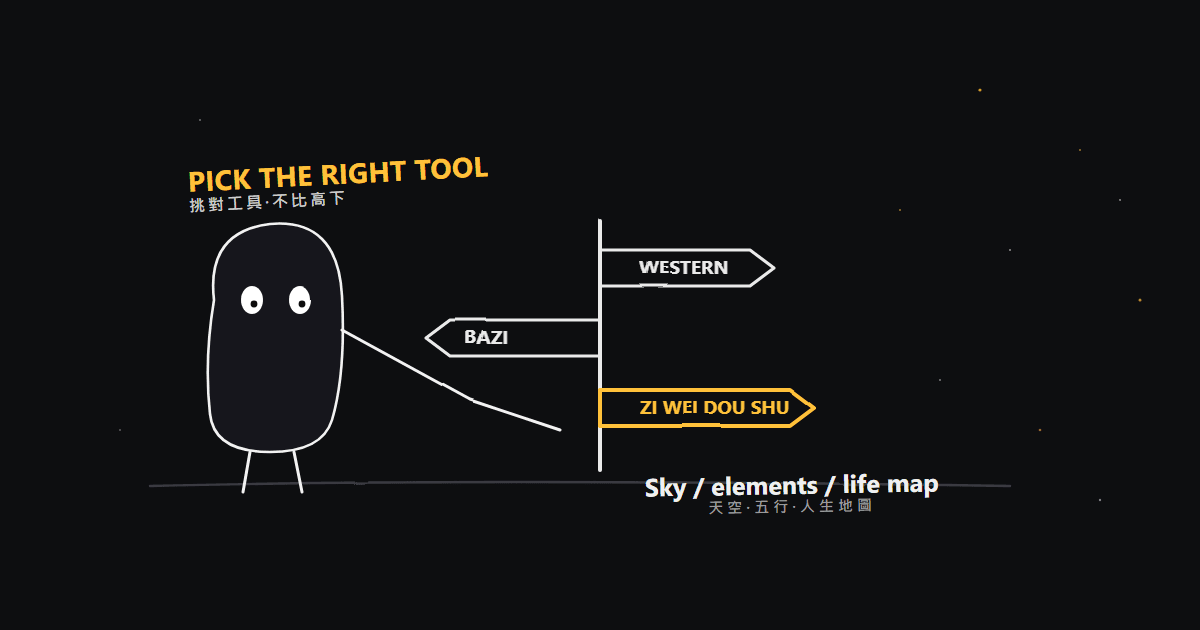
People new to Chinese astrology almost always ask the same thing: how is Zi Wei Dou Shu different from BaZi, and how are both different from the Western zodiac? Short answer: all three read a life from a birth moment, but they use different raw materials and answer different questions. Western astrology reads the sky, BaZi reads the elements, and Zi Wei Dou Shu reads a map of life domains.
This guide compares the three honestly — what each one is, what it is good at, and where each falls short — so you can pick the right tool for the question you actually have. It is a companion to our complete guide to Zi Wei Dou Shu.
The one-line version
- Western astrology — based on the positions of real planets and the sun against the zodiac. Great for psychological themes and personality language most people already recognize.
- BaZi (八字, Four Pillars of Destiny) — based on the Five Elements (Wood, Fire, Earth, Metal, Water) and the balance between them across four "pillars." Great for elemental temperament and long luck cycles.
- Zi Wei Dou Shu (紫微斗数, Purple Star Astrology) — based on symbolic "virtual stars" placed into twelve life-domain palaces. Great for a structured, area-by-area map of a life.
What each system actually uses
Western astrology tracks the literal sky at your birth: where the Sun, Moon, and planets sat against the twelve zodiac signs, plus the houses and the angles between planets. It is a celestial system — the inputs are real astronomical positions.
Curious about your own chart? Cast it free in 30 seconds →
BaZi converts your birth year, month, day, and hour into eight characters (hence "eight characters" / 八字) drawn from the Heavenly Stems and Earthly Branches. Each character carries one of the Five Elements. The whole reading is about how those elements support or fight each other.
Zi Wei Dou Shu also starts from year, month, day, and hour, but instead of elements it places about 14 major and ~100 minor symbolic stars into twelve fixed palaces — Life, Wealth, Spouse, Career, and so on. (See our guide to the 12 palaces.) It is a spatial system: a grid of life areas, each lit up by specific stars.
What each one is good at
- Western astrology is strongest at psychological and relational language. It is widely understood, so it is the easiest to talk about with friends.
- BaZi is strongest at elemental balance and luck cycles — it shines for questions like "what element do I lack" or "what is the flavor of this ten-year period."
- Zi Wei Dou Shu is strongest at specificity by domain. Because every life area has its own palace and its own stars, it answers pointed questions — "what is the structure of my career," "how do I relate to money," "what is my marriage palace saying" — more directly than a system that describes the whole person at once.
Where each one is weaker
No system is magic, and honesty matters here. Western astrology can stay general and personality-focused. BaZi's elemental view does not draw a clear "map" of separate life areas, so domain-specific questions take more inference. Zi Wei Dou Shu has a steep learning curve — twelve palaces times dozens of stars is a lot of moving parts, which is exactly why it benefits from a structured tool to keep the reading disciplined.
And all three share one limit: none of them predicts fixed events. They describe tendencies and timing, not certainties. Anyone selling "100% accurate" predictions in any of these systems is overstating what astrology does.
Can you combine them?
Yes — many practitioners cross-check BaZi and Zi Wei, since both come from the same calendar inputs. They can complement each other: BaZi for the elemental "weather," Zi Wei for the domain "map." But mixing them carelessly muddies a reading. FateStar deliberately focuses on pure Zi Wei Dou Shu, not a hybrid, because the twelve-palace structure is what keeps a reading specific and checkable rather than vague.
Which should you start with?
- Want familiar, conversational personality insight? Western astrology.
- Curious about your elemental makeup and big luck cycles? BaZi.
- Want a concrete, area-by-area map you can act on — career, money, relationships, timing? Zi Wei Dou Shu.
If the last one is you, cast a free Zi Wei chart or start a guided reading and see your twelve palaces laid out.
Frequently asked questions
Is Zi Wei Dou Shu better than BaZi? Neither is "better" — they answer different questions. BaZi reads the balance of the Five Elements and is excellent for elemental temperament and luck cycles. Zi Wei Dou Shu lays out twelve life-domain palaces and is better for specific, area-by-area questions like career structure or relationships. Many readers use both; FateStar focuses on pure Zi Wei for specificity.
Do Zi Wei and BaZi use the same birth information? Yes. Both are built from your birth year, month, day, and hour (ideally adjusted to true solar time at your birth place). They process that same data very differently — BaZi into elemental pillars, Zi Wei into a twelve-palace star map — which is why they can be cross-checked.
How is Zi Wei Dou Shu different from the Western zodiac? Western astrology uses the real positions of the Sun, Moon, and planets against the twelve zodiac signs. Zi Wei Dou Shu uses symbolic "virtual stars" — mathematical points from your birth time — placed into twelve life palaces. One reads the physical sky; the other reads a structured map of life areas.
Which Chinese astrology system is more accurate? Accuracy is the wrong frame. None of these systems predicts fixed events; they describe tendencies and timing. The more useful question is "which gives me the most actionable map for my question," and for domain-specific life planning, many people find Zi Wei Dou Shu's palace structure the most directly usable.
About the author
This guide was written by Louis Lin (林靖翔), founder of FateStar. Louis studied bazi and Western astrology before committing to Zi Wei Dou Shu in 2020 under his teacher, and has since read 300+ charts. He built FateStar to bring a rigorous, San He-school reading to people who do not read classical Chinese — with the honesty that a chart is a compass, not a guarantee.
What the classics say
The Complete Book of Zi Wei Dou Shu (Ming dynasty) says: "Not following the five stars' passing of solar terms - only the year, month, day and hour of birth." In this article's context: this opening declaration is the boundary stone between Zi Wei and BaZi: lunar calendar versus solar-term calendar. One birth moment, two coordinate systems, each internally valid.
Disclaimer: This article is for cultural, educational, and self-reflection purposes only. Zi Wei Dou Shu, BaZi, and Western astrology are traditional interpretive systems and do not constitute professional, medical, financial, or legal advice. Use them as one input among many, alongside your own judgment.
⚠️ FateStar generates and interprets your chart based on the traditional Chinese discipline of Zi Wei Dou Shu (紫微斗数). All content is for informational and reflective purposes only.
About the Author

Founder of FateStar. He began structured study of San He Zi Wei Dou Shu in 2020 and is responsible for product method, source organization, and content review. Personal experience is not presented as scientific proof.
More about Louis →